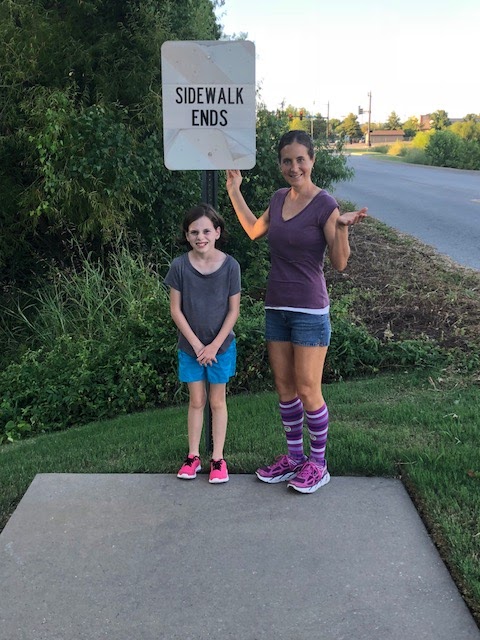
Thursday, September 6, 2018

Run for a Child 10K: Traditions & Surprises

The short:

It's been awhile since I've come down the final stretch of a race to see a finishing time faster than expected with less effort than expected, but it's sure a great feeling!  This was my fourth consecutive year running the Run for a Child 10K, and each year I've run faster there, although I didn't expect to continue that streak this year.  My race plan of "win with the least effort possible" turned into winning overall female by over 5 minutes with a negative split and a 37:55, which was a course PR.  It was one of those races where I felt like I kept gaining momentum and couldn't slow down - and those are rare to come by (I think the last time I felt like this was the Phoenix Marathon).  I was pumped about defending my overall female title from 2017, I was ecstatic to break 38 on the hilly course in warm and humid conditions, but I was most thrilled about just how good I felt doing it!  I guess God knew I needed a little confidence-boost at this point in my training, and I am very thankful for it.
The big check photos prop never get old to me
Packet pick up; I always travel in
compression socks!
The long:

I keep going back to the Run for a Child 10K each year; I am picky about races so this is saying something.  I know it's always going to be warm, humid, and hilly, but for some reason I can embrace that for this race, I think because every year is comparable.  My only goal going into the 2018 event was to try to defend my overall female title from 2017.  That fate of that type of goal always depends on who else shows up, but I never stress about it like I sometimes do when I have time and pace goals, because I have no control over the former and a lot of control over the latter.  I have a goal 10K coming up on September 9, so I also went into this one hoping to save my legs for that one.  I'd briefly considered trying to better my 2017 time, but after running an 8 mile tempo that was really rough on me on August 29 (details here), including inducing a little pull in my right hamstring, I decided holding back was a better option.  My husband and I discussed the plan the night before:  try to win while running as slow as possible.

The best laid plans, right?  The race went like this:
Serious starting line debates with my friend
Daniel, who was the male overall winner
Mile 1 - As the field spread out after the gun, I positioned myself just behind the fastest women and sat there.  The first 1.25 miles of the race is nearly all uphill, so I always go out slow, but she was slowing from what already felt very conservative, so at about 0.75 I threw the towel in on my plan and pulled into the first female position, moving along with a male who was passing.  I looked at my watch when it beeped splits during this race because that felt right (I hadn't really thought about it beforehand), and mile 1 was 6:32.  It was relaxed, but my main thought was, well, I really don't want to run over 40:00 so I'll just run the least it takes to be in the 39s, which would be in the low 6:20s from there on.  I "knew" at that point that my time would be slower than the past 2 years, and I was fine with that because a win seemed pretty secure even that early, which always makes it easier to relax.  The grade-adjusted pace of that mile was 6:14, so it wasn't as slow as the numbers showed, but it was slower than I'd gone out there previously.
Can you see why mile 1 is slow?
Mile 2 - I fell in step with a male and I could feel him speeding up.  I thought, well, it's always easier to run with someone so even if he's a little faster than 6:20 it will be an easier effort than running solo the whole race.  The next split was 6:14 and I felt like I was striding out better.

Mile 3 - I continued stride for stride with the male, and we were pulling in other men.  I started to pull away a little towards mile 3, and encouraged him to come with me so he would move up in place, but he fell back and I was on my own.  I felt like I was in a good place; putting in effort but still feeling really relaxed.  Mile 3 was 6:08.

Mile 4 - I had to smile as I passed the halfway point, because typically in 10Ks I pass the 5K feeling like there is no way I can run that distance again at that pace (even though I always do so I know that feeling is a liar - it occurs in nearly every tempo too), but in this one it seemed like an easy task.  I passed a couple of men and focused on the ones ahead of them.  Mile 4 has a lot of uphill in it and in the past I've always slowed in that mile, so was prepared for that if effort stayed equal.  When I saw my split of 6:10 I knew I was really having a good day.  I then figured I could try to be under 39:00.  In the past I've always been hurting pretty good at the mile 4 point of this race, but this year at every point I passed I kept thinking, "I feel so much better than every other time here", which is always encouraging!

Mile 5 - I felt like I was in a great rhythm and the effort was brisk but not dying (usually mile 5 of a 10K feels like dying).  I was running alone but there were two men within striking range, so I decided I'd try to pull them in.  That mile was 6:07.  At that point I was thinking I'd be somewhere around my 2016 and 2017 times (38:43 and 38:19), which was good enough for me!

Mile 6 - At this point I decided I'd try to run under 6:00 for the final mile for fun.  I passed one of the men I'd been chasing and kind of just felt like I was barreling in towards the finish.  I didn't look at my watch during or at the end of this mile, but I just knew I was running sub-6:00 (I've finished a lot of tempo runs with the same "sub-6:00 for fun" idea, and although those are on flatter courses I have a pretty good sense for pace).  The split was 5:56.
You can tell I'm not falling apart because my arm
swing form hasn't gone to crap like usual, haha!
Final stretch - I was gaining on the other man, so I decided I'd pretend he was a female and really try to pound it to catch him.  When the clock came into view during my final sprint, I saw it was still in the 37s, and gauged that I could actually make it in under 38, which really surprised me.  At that point it became just me and the clock, and I didn't even know if I beat the man or not until I looked at the photos Jon took (spoiler, I didn't).  My last 0.15 on my Garmin was 5:06 pace.  This course is certified, but my Garmin always reads it a little short, which the OCD in me dislikes but has also happened to me on several other certified courses (Rock the Parkway Half, Rock 'n' Roll Phoenix Half, White River Half, Phoenix Marathon).  I'm not sure if I dislike it more when it reads short or long (yeah, I haven't gotten the newsflash that Garmins aren't perfect and like to think mine is, and it kind of was at CIM and Grandma's)!
Eyes on the clock
I'm pretty sure I lit up walking through the finish chute, thinking "what just happened?!".  In 2017, I wanted to break 38 on this course and I wanted it to feel like less than an all-out effort (I was kind of demanding in 2017, hah).  But that year I ran a 38:19 with all I had and was disappointed I didn't have more.  I guess I accomplished my 2017 goal 1 year late!  The slow first mile really threw me off on finish time expectations, but I'm glad it worked out how it did, because the pressure of a time goal may have changed the outcome.  I was really excited about my course PR (also my 3rd fastest lifetime 10K), but I just couldn't get over how extremely smooth I felt doing it!  Especially considering how not good I'd felt on my recent tempo run in similar weather.  Race morning was 74* with a dew point of 70*.

Official results are here.
Garmin splits - course splits would
be a shade faster at 6:07 average
I love Strava's grade-adjusted pace feature
I love that this race does the big check photo prop at the awards!  I also love how we combine it with a fun family weekend (many photos from that below), so this is a tradition I hope we can continue!  There will come a time where I won't run a faster finishing time than the previous year, and I've also made peace with that.
Outtake
I hope to be running when I'm in my 70s like
Dr. Bob!
My progression for this race:
2018 - 37:55 and 1st overall female
2017 - 38:19 and 1st overall female, details here
2016 - 38:43 and 3rd overall female, details here
2015 - 40:22 and 3rd overall female (recovering from cryptosporidum so this one set the bar pretty low to start with)

Our traditional moms by the hotel pool selfie
Loves
Hotel pool = successful trip
Shel Silverstein wrote about this spot
Jon found a charging station for our Volt
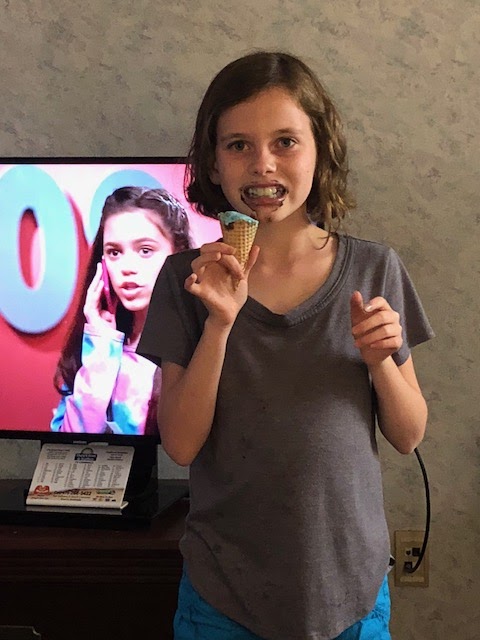
Ice cream & Nickelodeon also make any
vacation successful
The Amazeum was pretty amazing
I'm not sure this was the safest children's' activity
Never stop exploring or believing!

Monday, August 13, 2018

Tips for running on vacations

I am a big fan of running while on vacation!  I always see sights I wouldn't see otherwise, and I enjoy staying in my training groove.  I've learned a lot about how to make outdoor vacation running happen through trial and error, so I thought I'd share the strategies that have helped me...because not every trip can be a race trip, right??

I would have missed this if I hadn't run on vacation!

  1. Look at a map of your area.  I simply pull up the map app on my phone and look around my current location.  I've done this enough that I can typically determine a pretty accurate route from that map alone; for one run on my last vacation I eyeballed a loop I thought would be 4 miles, and it ended up measuring 4.1 miles (I was going to run it 3 times for a 12 miler, but then I found other places to explore, illustrating the importance of being open-minded)!  Look for:
    • Rivers and lakes.  There are often running trails that run along rivers and lakes, and you won't always find them online.  Find an easy way to get from your hotel to the water, and you'll often find great running paths once you get there!  I found a great path by doing this on our Niagara Falls vacation.
    • Parks.  Every park is going to have at minimum sidewalks around it.  Some parks are tiny and not of much help, but you can gauge that from the map.
    • Roads leading out of town.  When road tripping, we often stay in smaller towns along the way, and in the Midwest I can simply run out of town onto country roads.  I did this several times on our Niagara Falls vacation, our Minnesota/Canada vacation, and our Yellowstone vacation.
    • In town major roads.  If there are no great options for routes, running alongside a major road in town is often a good bet.  There are almost always sidewalks you can run on, and since you're running parallel to most of the traffic flow you won't have to stop for cars (cars coming off of side streets will generally have stop signs or lights, so will have to yield for you).  I did a lot of this on our Orlando vacation.  If you are at a big attraction like Disney, another option is running around the theme park parking lots, but we didn't stay on site so I didn't do this.  Parking lot loops can be helpful almost anywhere though; a mall parking lot can give you quite a bit of distance and will be a flat option if you have a workout.
    • Highways, so you can avoid running on them and crossing them.
  2. Ask at the front desk of your hotel.  Sometimes you'll get great advice on a nice running route; other times they will direct you to a park with a loop that ends up being a quarter mile; others they will look at you like you're crazy.  At minimum they can usually tell you the safest direction to go.
  3. Just run and you'll find something.  My husband always says that I'd run 10 miles around the hotel parking lot if I had to, which is not untrue.  Sometimes I just start running and see where it takes me, and I always find something.  Out and back courses are your best friend in this scenario!  I only run simple loops if I've verified them on a map beforehand.
  4. Run early.  Every route is easier to navigate at 5:00-6:30 a.m., and you won't have to deal with nearly as much traffic.  Running later in any city is just asking for a lot of stop/starting.
  5. Run with your phone.  I loathe running with my phone, but for safety I always take it when I'm running in unfamiliar areas.  It's also helpful if you get lost; I had to use it in Chicago once for this reason!
  6. Pack breakfasts and electrolytes.  If you're traveling with a group and you're the only runner, you might be running while others in your party go to the hotel breakfast; or the rest of your group may eat McDonalds for breakfast nearly every day (this was the case on our Niagara Falls trip).  I always pack oatmeal, protein powder, fruit, raisins, and nuts, and can always put together a nice breakfast out of this (you can heat water in your hotel coffee maker if needed).  Many vacations also entail sweating a lot, so I am extra vigilant about drinking water with nuun after running.
  7. Adjust pace expectations.  Remember that stress is stress and energy expenditure is energy expenditure.  Your body doesn't distinguish between training stress and other stress, and vacation can be draining!  Don't worry about slowing down your pace as needed.  Every day is different, and I haven't really found a clear pattern for myself regarding fast vs. slow vacation runs, but more are the latter and I don't put pressure on myself to perform the same as I would at home.  That's what the other 50 weeks of the year are for!
  8. Fit things in where you can.  It's amazing how much you can do if you're creative about it.  I fit in about 90 minutes of strength work on my last vacation, nearly exclusively during road trip rest stops and while waiting for others in our group at the hotel.  Another technique that's helpful is when your group goes to a sit down meal, tell someone else your order and go run while everyone gets seated, gets drinks, orders, and waits for their food.  You can easily run for 30 minutes then change while this is occurring, and then sit down to refuel!
Running on vacation may not be for everyone, but it is for me!
You can read related posts here:
Running on vacation in general
Our 2018 trip to Niagara Falls and what I ran during it
Our 2018 Minnesota and Canada vacation, and what I ran during it
A briefer mention of our post-CIM 2017 California vacation
Why being an endurance athlete is helpful on a Disney vacation
Disney vacation part 1, with runs detailed
Disney vacation part 2, with runs detailed
Disney vacation part 3, with runs detailed
Disney vacation part 4, with runs detailed
Our 2016 Yellowstone vacation, and what I ran during it

Tuesday, July 31, 2018

The saga of inaccurate 5Ks continues: Girls Just Wanna Run “5K”

Perhaps someday I will run an actual 5K, but 7/21/18 wasn’t the day!

I ran the Girls Just Wanna Run 5K for my final summer short race.  I initially didn't think I'd be able to race on July 21 because we were leaving on vacation that morning, but when my husband told me we couldn't pick up our rental car until 9:00 a.m., I decided starting a local race at 7:30 a.m. was feasible.  It was the last weekend I had a short long run before marathon training amps up, and it was a relatively large women's only race (373 finishers) that I thought would be fun to try to win.  I mapped the course on mapmyrun from the online course map, and it read 3.10 (bingo!!), so I signed up at the expo!
Race shirt, after a different run
I was scheduled to run a 10 miler with 3 miles progressive fast finish, so I decided I'd try to run the race as a progression run, provided that I could go for the win running that way (since past winning times had been over 20:00, I suspected I could).  My goal splits were 6:20, 6:15, 6:10, then sprint the final 0.1.  I knew the course map well enough that I thought I'd be able to easily run it for a warm up, assuming it would be marked, but when I began my warm up I didn't see any markings so I ran the general area but not the exact course.  I was relieved to see a lead cyclist when I lined up!
Lead cyclist shown here!
I went out conservatively, and found myself out front less than a half mile in, so I felt my chance of winning with the progression run pace plan was good.  The lead cyclist was just in front of me, the course volunteers were enthusiastic, and I was right around my pace goal for mile 1.  I looked at my watch when it beeped - 6:19.  The course wasn't marked at all, but I was following the cyclist, which seemed simple enough.
Can you find me?
Not too far after the mile, the lead cyclist and a volunteer disagreed which street a turn was, which did not inspire confidence.  I remembered which street the course map showed us turning on, and the cyclist took me one block too far north.  At that point I thought, "Oh, geez, now it's going to be 2 blocks long", and mentioned that we were supposed to turn on Blaine, not Commercial, as the volunteer had said.  The lead cyclist said that the race organizers had told him the course was the same as last year, which meant a turn on Commercial.  We had this conversation during the race/progression workout, and I wasn't going to not follow him, so I continued on.  The cyclist then started second guessing himself and said he was going to go back to clarify for the volunteer, and I pleaded, "But I don't know where to go!" so he stayed with me.

I didn't know where our next turn was supposed to be, but he thought he did, so I continued on with my workout, thinking that we were going to run 2 blocks long.  Mile 2 was 6:16, so I was right where I wanted to be with my progression run, and just reminded myself to focus on hitting my paces and not getting upset about the distance.  We started nearing the finish line, and I realized it was definitely not going to be long, but in fact quite short (2.68!).  I finished 1st overall in 16:17, with my final split pace being 6:01.

I was disappointed because it was clearly a short course.  I told the finish line workers that I hadn't actually run a 16:17.  The lead cyclist only knew about the 2 blocks he'd added going north/back south, not the 6 that he'd cut off going east/back west, and he kept apologizing to me for making it long and insisting to the race organizers that it was long.  I can only wish I'd run 16:17 for a long 5K (or for an accurate 5K...or even for 3 miles!)!  I didn't know exactly where the second error occurred until I compared my Strava map to the course map, but essentially I ran 4 blocks less than I should have.  In the end, the race added 2:00 to my time for the 4 blocks, for an 18:17, which is still faster than I would have run per my Garmin, but at least closer! 

Official results are here.

I won a nice Thirty One brand over-the-shoulder large lunch tote for my overall award, which I grabbed, along with some great snacks, after my cool down before hurrying home to start our vacation!  One of my co-workers bought a similar lunch bag the week before, and I'd admired the size of it and ease of carrying it (we are always lugging a million things in and out of the building), so it was a timely and functional award!
Winnings

Saturday, July 14, 2018

Fleet Feet track meet: If you think a 5K is short, try a 1 or 2 mile!

Because, why not run a 3200 m on the track against a bunch of teenagers in ridiculous heat and humidity?  Clearly I am getting crazier by the day, but this free Tuesday night track meet seemed like a great way to knock out another 2018 short race, and I ended up knocking out two!  Who cares if I was old enough to be the mother of most of the other females in the races and ran approximately my half marathon pace?
If you can't laugh at yourself, you're missing out
When I mentioned running the 2 mile at this meet, my coach said to do it as a "legit workout" (even though I'm not starting back to real workouts until August), but to keep my typical training pattern up I ran a normal run the morning of the evening meet.  Instead of doing an easy pace 4 mile double, I planned to run the race (2 miles hard along with a warm up and cool down) for my first double in 5 weeks.  Now that I'm writing all of this out, it seems like a worse and worse idea...you know what they say about hindsight!  But it was free and at a track only about 6 miles from my house, so it seemed like a crime not to do it.  If I was truly being crazy I'd have run to and from the meet as well (goals for next time!).

We arrived at the track around the 7:00 p.m. meet start time.  The website had the 2 mile (which was actually a 3200 m) listed as the second to last event in the approximately 1 hour meet, so I expected to start around 7:40 p.m. at the soonest, and thought I had plenty of time.  Jon and Albani positioned themselves in the stands, and I went down to the track to talk to a friend who'd asked me to be on her 4 x 100 m relay (clearly they were desperate for a fourth person).  She told me that they'd announced that the 2 mile was the second event; they were running things in the reverse order as they were listed on the website.  So I had only the time that it would take to run the first event, the 400 m races, to warm up!  I hoped there were a lot of people in the 400 m and took off!

I ended up having time to run 1.4 miles (although I had to sacrifice a pre-race pee stop for it), so it wasn't terrible - but I need at least 2 miles to warm up properly for anything fast, preferably 3; I always run the course before any 5K.  I did not do any strides, drills, leg swings, etc., but I thought running with the time I had was the best way to maximize it.  I ran until they called the 2 mile, and then jumped on the starting line dripping sweat.  They ran men and women together, so it was a decent sized group.  The announcer (who was also jumping into races between announcing the meet) said, "We've got a ringer in this one, Sara Ibbetson" and after asking him what that meant, I told him that my 2 mile pace was about the same as my marathon pace so not to expect much.  Then he announced "Her 2 mile pace is her marathon pace, but it's fast, almost an Olympic Trials Qualifier marathon!", which was one of the highlights of the meet for me.  Then we were off!
3200 m start
I got out pretty slow even for me (1:36 first lap) because I wasn't warmed up enough, but then I settled into right around 1:30 for each lap.  I wore my Garmin for the data, but they were calling off the elapsed time each time we passed the finish line so I knew where I was at whether I wanted to or not.  My elapsed times were 1:36, 3:06, 4:37, 6:07, 7:39, 9:11, (did not get lap 7), and 12:15 for my total.  My 1600 m splits were 6:07 and 6:08 so I was very even.  I turned off auto-lap on my Garmin since I knew it would be off on the track, and my Strava was definitely off.

The race itself was pretty anticlimactic; I took the female lead within the first 200 m and spent the first 800 m passing teenage boys.  For most of the race I was pretty much in no man's land; there were 3 men in front of me but they were way ahead; the first male broke 10:00 and lapped me (hangs head in shame), and 2-3 were 11:10ish.  It wasn't long before I started lapping people, and some I lapped twice, so I had to run in lanes 2-3 quite a bit.  I got out-kicked in the final 20-30 m by the meet director/announcer/local Fleet Feet owner who I'd passed before the mile mark; I didn't realize he was close until it was too late and he went flying by me (although he probably ran a 1:15 last lap or something so may not have been close until then).  I had fun, and knocked out my first 2 mile tempo of the season!  Although I didn't have any performance expectations for this race for many reasons, running my half marathon pace for 3200 m seems pretty sad -- but I'd seen the post below from Kellyn Taylor a few hours before the event and it made me feel better that she'd run slower than her marathon pace for pushes on a 10 x 1 minute fartlek that same day!

Right after the 3200 m, I got Albani into the 200 m.  They'd originally said you had to be in 7th grade to participate in the meet, but they let her in as a 5th grader.  She beat the other youngster in her heat and ran a 0:42 200 m, which I thought was really good!  She had fun but she didn't know that you were supposed to stay in your lane on the 200 m because she's only watched me run long track races where you don't stay in your lane, and I didn't think to tell her.  Oops!  She only moved over 1 lane (towards the outside, so she ran farther), but it might have been to cut off her competitor...
Look at that stride!
Relay baton practice
Shortly after, I got recruited to run a 1600 m on the distance medley relay at the last second.  Nothing like - surprise, you're racing a mile starting in 30 seconds!  I ran an honest effort, but it felt much easier than my 3200 m effort, so I was surprised to squeak in under 6:00 (5:59); I guess I was finally warmed up after the 3200!  For anything short, I cannot make my legs go any faster, but I can keep going.  I couldn't run any faster than 12:15 on that 3200 m, but I think I could have run 3-4 3200 m reps at that pace.  I'm not sure if that's age or all of my marathon training or what, but I have a goal to work on it!  It's hard to judge too much by this event (or the summer 5Ks I've run), though, since the heat and humidity were so oppressive.
DMR start
Albani's 4 x 100 team plus one
Then Albani and I both ended the night by starting 4 x 100 m relays.  I told my relay in advance that my 100 m pace, much like my 1600 m and 3200 m pace, was also my half marathon pace, so they were warned.

Albani enjoyed Zach and Shelby's dog just as much as the running and ice cream bars at the end!
This dog stole the show
All in all, this was a really neat event that our local Fleet Feet put on.  It was great to see runners of all abilities out there enjoying themselves.  Rumor has it that they might include a 5,000 m next year, and if so I will probably try to race it "for real" (e.g., not run a lot of miles that morning or work non-stop all day), although a July evening in Missouri is probably never going to be the time to run a fast time in anything, so I should probably just stick with the goal of running to and from the meet.
Team Ibbetson
Jon was a great cheerleader but I couldn't get him to run!


Wednesday, July 11, 2018

Set goals that make you want to jump out of bed in the morning!

While recovering from Grandma's, I've been pondering goals for my next marathon build.  I will be running the California International Marathon again this year, and I hope to:
  1. Set myself up for a fast marathon on December 2.  I've been working with the same coach for nearly 3 years now (my only coach as an adult), and I trust he will structure my training to accomplish this, so running what he tells me to run each day is an easy goal.  I imagine he will bump up my mileage a bit this cycle, but I'm not sure what else is in store.  I'm excited to find out!  My 2:45:00 or faster Big Dream Goal hasn't changed, but I also recognize I can achieve the fast marathon goal without hitting the 2:45:00 or better goal (2:45:01-2:48:59 also = fast marathon, for me -- and not that 2:49 is slow, just that is not my goal).
  2. Improve my get-up-and-go speed.  I have a hard time getting up to speed, which in some aspects is helpful (e.g., I negative split everything), but hinders my speed work and short distance running.  If I'm running a 1:25 400 m, I'm running the first 200 m in 0:45 and the second 200 m in 0:40, which really isn't ideal.  I'm going to work on this with strides that have walking/standing recoveries between, by incorporating more explosive plyometrics, and by lifting some heavier weights.  It's not essential for the marathon, but if I get faster I hope that will make marathon pace feel slower and therefore easier.  Currently there is not much differential for my pace across different race distances, which again favors the marathon so isn't the worst thing ever...it just seems that my 5K pace should be more than 20-30 seconds/miles faster than my marathon pace.
  3. Vary my training routes even more.  When I was training for CIM 2017, I got stuck on running the same routes, in particular what I thought were the fastest routes, even on easy runs.  Everything I run from my house is hilly to some degree, but how the elevation is distributed makes a difference in pace for me  (the "fast" routes are gentler rollers with more even elevation distribution).  After Houston, I made a goal to start exploring different routes, and I've been running a lot more courses than I was before then, but I am very blessed to live in a rural area with countless safe options.  During my recovery running, I've already added several new routes to my repertoire.  They've all been hillier, hah.
  4. Get more sleep.  This will be the most challenging goal for me, because it's hard to get enough sleep when you're getting up at 4:30-5:00 a.m. every day.  Even when I don't set an alarm, and no matter what time I go to bed, I pretty much always wake up between 4:30-5:30 a.m. (the latest I managed to sleep on our whole Minnesota vacation was 5:40!), so I simply have to get to bed earlier to accomplish this.  Since it takes me at least 30 minutes of reading in bed to fall asleep, I really need to be getting in bed my 8:30 p.m., which is Albani's school night bedtime.  8:00 p.m. would be better, but since I typically don't get home from work until close to 6:00 p.m., that's difficult!  If I run a double in the evening, there is truly no hope, so I try to do most of those at lunch. 
  5. Balance running what I want to do vs. the "perfect" training cycle.  In my 2017 training cycle for CIM, I was really focused on making everything "perfect"...I skipped races that I wanted to run in favor of workouts or mileage that I thought was slightly better, I wanted to hit certain paces on every run, and it was really important to me that all of my data showed I'd had my best training cycle ever.  I did, but I obsessed too much about it.  Then my cycle for Grandma's was the polar opposite...I felt like very little went right until the very end.  My performance was about the same at Grandma's as it was at CIM when you account for course differences, which is kind of humorous based on all of this.  There is definitely a happy medium in there and I am going to strive to find it!  I am confident it includes training well, but not worrying about each mile pace or every single workout and long run in isolation; it's the big picture of consistency day after day that matters most (plus our bodies know effort, not pace).  The biggest "imperfect" part of my current plan is that instead of running a 24 miler 3 weeks prior to CIM, I am going to run a local marathon at training pace 4 weeks prior for my longest long run.  I wanted to do this last year, but didn't due to that effort for perfectness ("It must be 3 weeks before and it must be 24.X miles in the same total duration I want to run the marathon in").  I am really excited about doing it this time and it also means I "only" have to wait 17 weeks to run another marathon, instead of the 21 until CIM!  To make it even better, I will be pacing a friend in her sub-3:00 attempt that day, since 6:50ish is an ideal training pace for that run.
While I'm excited about these goals, I've also gone through a bit of a post-marathon slump.  This is pretty normal for me, and I have learned that when we vacation immediately after marathons, the slump is delayed.  That tricks me because I think I've avoided it, and then it hits!  I am mainly falling prey to negative thinking...I am worried that I'm never going to be able to make improvements beyond where I'm at right now, or, even worse, that I am getting slower every week.  I feel "behind" where I was in 2017 at this time, and I also worry about my lack of speed.  I am sharing this bit not to whine or complain, but to be real.  I appreciate when other runners share both their highs and lows, because we can all certainly relate to both!  I'll keep plugging away and let this next cycle bring what it may.
Looking forward to our 1 year reunion in
December, CIM!

Sunday, July 8, 2018

Shufflin' at Shuffle for the Shelter

I am doing a summer of short races.  I considered using the phrase "summer of speed", but I am not sure that anything I run will actually be speedy...in fact, I am more sure it will not be!  These marathon legs have a hard time getting turnover.  I sure admire those people who race equivalent performances at all distances in the same season!

I participate in a yearly competition my running club hosts that requires a certain number of races in different distance categories.  The races that I have run/have planned for 2018 fulfill all I need (and then some) for every category except for short distance.  I had one 5K on my 2018 schedule, a local fall race that I run because of the prizes offered.  I need to run 5 short distance races total, so I had the bright idea that I would run the other 4 when I'm between marathon training blocks (and of course running no speed work).  I knocked out the first at the Duck Waddle on June 30, and the second one a week later at the Shuffle for the Shelter on July 7.
It was quite sunny, & I forgot to change shoes so raced this
in Hoka Cliftons
I figured the race would be small since it was an inaugural event, and I also figured it would be the wrong distance because pretty much every race in my area that isn't certified is off.  I just secretly hope that if they're wrong they will be 3.0 instead of 3.2 (I've also had 2.6 and 3.4...)!  I tried to plot the course on mapmyrun.com from the course map before I decided to go to the race, and kept coming up with 3.2-3.3, but I couldn't map it quite right because it started and finished in a parking lot, had a turn around that I couldn't quite figure out (on race day I learned that it was also in a parking lot), and it wasn't clear exactly how the two loop course worked - so really I couldn't tell.  It was my only local race option this morning, and we are going to be on vacation on July 21 and 28, so I didn't have too many other options to get the races done before my Saturday long runs become long and important again.  A slower time is also better than not having the minimum number of races in my running club's competition, because in the latter scenario you can't compete in the contest at all.

On race morning I was the annoying person asking a million questions, because I was trying to run the course for my warm up and was not familiar with the area, and as I mentioned had struggled with the course map.  The race organizers were very kind and helped me figure out the course, and also told me there would be a bike lead.  I then ran the course for my warm-up, and it measured 3.43, but then I learned I didn't have to go all the way through the starting line before starting the second loop, so I still didn't know how long it actually was.  The race organizers were so nice that they even checked in with me on what distance it was before the start, since I'd been asking about the course beforehand.  I doubt they expected someone to be so concerned about the precise distance of the small fundraising 5K, and they probably complained about me later (not really, they were extremely nice people, but I did have a lot of questions - I also made sure to compliment all of the things they did well)!
Just after the start
After the race began, I was out in front pretty quickly.  Having the lead bike to follow was very helpful, although the course was also well-marked.  I ran by effort, but looked at my watch when we finished the first loop to see the distance (1.60).  On the second lap, I completely let the pedal off the metal...I just didn't have it in me to hurt.  In the end my splits looked like 1 mile at 10K pace (5:59) + 1 mile at half pace (6:08) + 1 mile at marathon pace (6:27) - for 6:12 average for the 3.19 mile race.  I was almost embarrassed to share my splits, but we've all been there, right?  I just couldn't go to the race pain cave...I think that had something to do with running 5Ks a week apart.  In the Duck Waddle I hurt a lot in the final mile, but I also ran quite a bit faster, and I hope that I negative split.  I'd originally planned to run a Firecracker Run too, but I'm sure glad that didn't work out - I doubt I'd have had that in me (on July 4 I fast finished a 9 mile run in 6:22, 6:26, 6:11 and really don't think I'd have raced much faster than that)!
The lead bike looking back for me
I finished about 90 seconds ahead of the second runner (the overall male), and received a gift certificate for a free massage for my award, which I was really pumped about, particularly because I wasn't expecting it.  The race organizers were so nice and did such a great job for a first year event, I couldn't even be annoyed about the course.  Plus, the Duck Waddle was a little short, so I figure my times will balance each other out in my running club's competition, and at least I got a massage for my solid regression run effort!  Results are here.  Only two more summer short races to go!
Can't wait to redeem this!
I made it into the Marshfield Mail newspaper


Late addition to this post - how sweet is this that they sent
thank you notes to participants?!  I've never received one
 before in my 26 years of running.

Wednesday, July 4, 2018

Books in 2018 - Second Quarter

This continues my un-originally titled Books in 2018 Series.  The first quarter list can be seen here.  I suspected I would have a shorter list in the warmer weather months, and that hypothesis was correct!
My little reader
April
  • The Walk by Richard Paul Evans - I'm continuing to read Evans's work, which I mentioned often in my first quarter list.  This was the first book in a five book series and left me ready to read the others.
  • Heaven is Here by Stephanie Nielson - I recommend this memoir.  It was very touching!
  • Miles to Go by Richard Paul Evans - The second book in The Walk series.
  • A Step of Faith by Richard Paul Evans - The fourth book in The Walk series.  Neither my library nor the associated branches that I can do inter-library loan from have the third book, which makes no sense.  From reading the second one I knew that the books could stand alone, but this was also frustrating!
  • Walking on Water by Richard Paul Evans - The fifth book in The Walk series.  Definitely read this series!
May
  • Bridget Jones: Mad About the Boy by Helen Fielding - I read Bridget Jones's Diary years ago, so when I randomly saw this one at the library I picked it up.  It was nowhere good as I remember the first book being.
  • I Was Told There'd Be Cake by Sloane Crosley - This memoir was also okay, but nothing you need to add to your reading list.
  • The Broken Road by Richard Paul Evans - I didn't realize that this was the first book in a new trilogy when I picked it up; I prefer to wait until the entire series is out so I can read them straight through.  I will be anxiously awaiting!
  • Hello Sunshine by Laura Dave - This was an entertaining one and I hope to read more by this author now!
  • We Are Never Meeting in Real Life by Samantha Irby - I finished it, but I wouldn't read it again or pick up another book by this author...I am more conservative than she.
  • Bridget Jones's Baby by Helen Fielding - I liked this more than Bridget Jones: Mad About the Boy. which I'd checked out at the same time, but still think you can find better books.
June
  • How Did You Get This Number by Sloan Crosley - I liked this better than I Was Told There'd Be Cake.
  • My (Not So) Perfect Life by Sophie Kinsella - My friend Liz posted about reading this book, and I've enjoyed other books by this author so I checked it out from the library the next time I had the chance and enjoyed it.
  • The Forgotten Road by Richard Paul Evans - This was the second book in a trilogy (The Broken Road, which I read in May, was the first), but the third book doesn't come out until spring 2019, ugh!  This was a really good read.
  • The Noel Diary by Richard Paul Evans - This one wasn't as holiday-themed as you'd think by the title, and his books never disappoint.
  • The Rosie Effect by Graeme Simsion - I'd read The Rosie Project and didn't realize there was a second book until Liz mentioned it (clearly I enjoy reading her reading lists!).  I agree with her that the first book was better.
  • Summer Secrets by Jane Green - I finished this on my Grandma's Marathon trip and highly recommend it and anything else by Jane Green.  I read every book she'd published several years ago, but now more have come out and I need to catch up!
  • The Chaperone by Laura Moriarty.  I purchased this one in a little book shop in Grand Marais, Minnesota because I'd nearly finished the three books I brought on the trip but still had about half the trip left.  It had some unexpected twists, and I've liked everything I've read by this author (The Center of Everything is a really good read from her).
Mid-May Albani started our library's summer reading program, so now she earns bonuses for the reading she does anyway!  I signed up for the adult program, but logging her reading was so involved that I never logged my own.
This is an amazing coupon book!

Tuesday, July 3, 2018

Threepeat at the Duck Waddle 5K

I'd pick a marathon over a 5K any day, and before this one I realized that I hadn't raced a 5K in quite awhile!  I am participating in my running club's 2018 Runner of the Year competition, and I need to run 5 short distance races (5K or under, but don't think I'm even considering a 1 mile!) during 2018 for it.  Before June 30, I'd run exactly 0.  I decided I wanted to knock 4 of them out this summer so I don't have to fit them in around longer long runs and my fall goal races (the fifth is planned for October).

I don't have any expectations for any of these 4 summer 5Ks, aside from giving what I have each race day, and that made racing this one less intimidating.  This was my third year running the Sertoma Duck Waddle (2017 recap here, 2016 recap here), and I'd won overall female both previous years, so my main goal was to make it a threepeat.  Another reason I chose to return to this race was because, despite not being certified, the course has always been reasonably accurate, which is often not the case in my area.  Historically I have run "5Ks" in the 14:50s and the 21:30s due to grossly wrong courses!

After learning that the 2018 course was not the same as the 2017 course or the 2016 course, I decided I'd run it for my warm up so I'd be able to follow it and would know if it was accurate.  There was no course map available, but luckily all of the signs and markings were up when I started warming up around 7:30 a.m. for the 8:00 a.m. race.  Did I mention we were in an excessive heat warning on race morning?  I didn't even look at the weather beforehand because I knew it would be bad, but when I finished my cool down the heat index was 92 degrees, with 70% humidity.  Of course I'd have run this day regardless, but I'd have definitely started a training run at 5:30 a.m.!

The course was decent aside from 4 hairpin turns, and about half of it was shaded, which was nice! My Garmin measured it at 3.07 miles when I ran it for my warm up, and I dripped sweat while changing shoes and getting a final drink.  I headed to the starting line for some final strides and drills, talked to several local runners I knew, and waited for the race organizers to figure out how to open a gate in the park that was padlocked shut and blocking the race course.  Then we were off!

The woman who was second place in the 2017 event was in the race again, so I figured I might end up running much of the race with her like I did last year.  She was beside me for about the first half mile, and we commiserated about a hairpin turn together before I began pulling ahead.  There were several high school age boys ahead of me and one 20-something man.  I passed some of the boys and when I pulled up next to the man, he fell in stride with me.  He and I ran side-by-side from about 0.75 to 2, which was helpful and pushed me.  He was breathing a lot harder than I was, so I started questioning if I was actually pushing myself hard enough, but I sure felt like I was dying!  Dropping below half marathon pace always feels deathly fast to me.
This is the face I make when dropping below half marathon pace
He started to fade in the final mile, so I set my gaze on the one boy left in front of me.  He had a lot of real estate on me, so I knew I wasn't going to catch him unless he really died (spoiler:  he did not).  I felt like I was fading but what's mile 3 of a 5K if you're not having a coronary?  We had a helpful 200 m+ downhill in the final half mile and the race was over almost as quickly as it had started.

I couldn't see the finishing clock until I was right on it, and all I saw was the 18.  I stopped my Garmin to see my time and it read 0:01, 0:02...  I thought I'd pressed start at the race's start, but apparently I hadn't actually started it (this same thing happened to me at the Plaza 10K, although that was when I was looking at my watch a lot during races so I still captured 5.9 miles of it).  I've been racing by effort more often than not this season, so I didn't realize my Garmin wasn't running since I wasn't looking at it.

I was disappointed that I didn't have my splits, or the course distance, because my official time of 18:11 is a really good 5K time for me -- it would in fact be a PR, but with this course not being certified and my Garmin having it short on my warm up, it's not.  My Garmin usually reads right on or a little short on straight courses, and a little over on courses with more curves and turns, and this one was the latter.  My Garmin measured it at 3.07 so I figure it would have measured 3.12-3.13 for a full 5K on that route - I think I'd have run 15-20 seconds slower for a certified 5K. That's still a solid performance for me, and almost exactly what I ran at this race last year when I was not 2 weeks off of a marathon.  I was also happy to accomplish my threepeat goal.  I was not quite as happy to "cool down" as the temperature continued to rise, but I was validated in my choice to run this when I didn't have a long run on tap for the day so I didn't have 10 miles to add on afterward (I actually had no training schedule at all, but I wanted to run at least 10 miles total for the morning so added 4 after).

How can you not love a duck trophy?
I got my own results page
Full results are here.

I am going to try to run 3 more short races in July and August.  I have several possibilities but it depends on my family's schedule and how quickly I get over the pain of racing each one, hah.  I'm sure it's good for me to tackle the acute pain that is the 5K, and the shock to my body that is running sub-6:00 pace, so I'll embrace the opportunity to work on my "speed" while getting these done!

Thursday, June 28, 2018

Caffeine Taper, Pre-Race Meals, & Marathon Day Nutrition

What you run during race week matters, but not nearly as much as what you’ve been running consistently during marathon training. Much in the same way, what you eat race week and race day matters, but isn’t as important as what you’ve been consistently eating throughout your training build. Really, you can’t gain much based on either just before the race, but you can screw it all up! Everyone knows not to run 15 miles the day before the race and not to eat jalapeno poppers the night before the race, but we all like hearing about how everyone else fine tunes their tapers and their fueling. Here is what works for me!

Before my last 3 marathons I've done a caffeine taper.  One week before a marathon I cut out all caffeine. I usually stop drinking coffee about 3 weeks before, then gradually wean myself down with tea and nuun energy. My caffeine taper wasn’t easy before Grandma’s Marathon, and I almost gave in on the first day when I experienced a withdrawal headache, but I made it through! Caffeine is a proven performance-enhancer, and by abstaining for 4-5 days before a goal race, you can theoretically maximize the performance-enhancing effects of caffeine on race day. I just do a full week off of it so I can begin my abstinence on a non-work day! I first read about this technique in a couple of blog posts by Neely Spence-Gracey (found here and here). On a typical day when I am not doing a caffeine taper, I drink one travel mug sized cup of coffee each morning during my commute (after my early morning run). On some key workout and long run days I have a nuun energy tab in water prior to my run (1-2 times a week at most), and sometimes I’ll have a cup of tea or a nuun energy tab mid- to late- morning at work, so I'm not consuming pots of coffee, multiple energy drinks, etc. at any time (those drinking several caffeinated beverages daily might struggle with something like this more).

The week leading up to the race, I eat the same as I’ve been eating the entire training cycle, which I would describe as mostly clean and well-balanced. I eat from all of the food groups and emphasize whole and natural foods. I don't count macros or calories or subscribe to a specific diet plan. I eat quite a bit of fiber on a regular basis (whole grains, fruits, veggies), and don’t change that because it doesn’t adversely affect me during races.

In the final 3 days before the race, I increase the percentage of carbs I’m eating. I still don’t count anything, but make common sense substitutions (oatmeal and toast instead of an omelet for breakfast, fruit and pretzels for snacks, two potatoes and a small piece of chicken instead of a large chicken breast and one potato, etc.). I also add more electrolytes into the water I’m drinking, using nuun.

I try to keep my food choices familiar, including packing quite a bit of food when traveling to races. We left home for Grandma’s on Thursday morning, so I had 6 meals between home and the race, and I packed 4 of them. I ate out for dinner on Thursday (a chicken, rice, and veggie bowl that was very brown rice-heavy), and for lunch on Friday (a Subway foot-long on whole grain with eggs and all the veggies), all typical foods for me. I packed a cooler with a couple of servings of a leftover quinoa/lentil dish that I ate for Thursday’s lunch and Friday’s dinner -- yes, I ate lentils the night before the race, along with a sweet potato with skin..like I said, fiber doesn't bother me. I also packed some hard boiled eggs and lots of carby snacks (fruit, pretzels, bars, bagels, electrolyte chews).

Race morning I eat a large baked sweet potato without skin about 3 hours before the race. I also start sipping on nuun energy in water, which contains electrolytes and caffeine (40 mg/tab and I have 2 tabs). I gradually drink this, finishing most of it by an hour before the race. 2 hours before the race, I begin sipping Generation UCAN vanilla mixed with either almond milk or water. I use 3 scoops of UCAN so it’s pretty dense calorie-wise but doesn’t weigh heavy on my stomach, which is important because I am used to running on an empty stomach.

During the race, I take 3 Accel gels, around the 10K, 20K, and 30K marks. Each of these gels contains 40 mg caffeine. At Grandma’s I picked them up at miles 5, 13, and 19 because those were the closest bottle stops to where I wanted them. I had water in the bottles I took with the gels. I also placed nuun energy (half a tab per bottle) at miles 7, 15, 22, and 24. I drank probably half the 8 oz bottles at 7 and 15, and the whole bottle at 22 (that was a mistake though, because I got a terrible side cramp that lasted 2 miles after I did it). I didn’t take the bottle at 24; it was mainly just there for if I was dying and fortunately I wasn't. I took sips of water at some other course stations. In most previous marathons I’ve drank water only, because the sports drinks on course always seem to be mixed to different strengths and the brands don’t always agree with me, so I prefer to rely on my gels with water. CIM had nuun (not nuun energy though) on course so I took some of it there.

All of this in combination works great for me! I feel like I have enough fuel to sustain me throughout the race and don’t experience any stomach or GI issues. Nutrition and especially during-race fueling is different for everyone, so I encourage you to practice your race day plans before and during long training runs and workouts so you know it will work for you. I’ve done this overall routine for 6 marathons now and it’s gone smoothly each time. I’ve only done the caffeine taper part 3 times, and it's certainly the hardest part, but every second counts!
During race nutrition