Sunday, February 7, 2021

Cabin Fever Relieved: Cabin Fever Reliever 20k

The short:

"Happiness is reality minus expectation."  I always realize how true this quote is when I run a race that exceeds my expectations, even if it's not a top performance.  I chose the local Cabin Fever Reliever 20k as a rust buster, and after running the difficult course in training I figured if I could run in the 6:30s it would be a great day - as in, anything under 6:40 pace would be a success.  I ran by feel because I always seem to race best that way, and as I neared the finish line I saw the clock still in the 1:19s so I kicked hard to get in excitedly at 1:19:41, which is 6:24 average pace and technically a PR.  I was the 1st overall female and broke the Missouri state road racing record for 20k for age 40; plus only two women in Missouri of any age have ever run faster 20ks.  I was most pumped by how strong I felt throughout the race in spite of sub-par conditions (hills, wind, running solo).  It was a great reminder of how much I love racing. and I can't wait to do it again!

Official results are here.

State 20k records are here.

Colin was 2nd OA male in the 20k,
Casey was 1st OA female in the 10k

The long:

I busted the rust after over a year away from racing (my last was the Houston Marathon on 1/19/20)!  The Cabin Fever Reliever was the perfect way to ease back into competition, because it is a small event, it takes place less than 10 minutes from my home, and it is an uncommon distance.  For a related bonus, the Missouri State single age road racing records for the 20k distance are soft, as was my actual 20k PR, although I wasn't exactly sure what it was.  I ran a 20k time trial in September 2020, but time trials definitely have asterisks in my book, plus I didn't think I could beat that time anyway, hah.

I didn't taper for this race, mostly just because I was in a groove with training and didn't want to, but also because the weather was decent and my season goal races are in March and April.  I ran 87 miles the week of the race, but I ran my workout on Tuesday instead of Wednesday to try to give my legs a little extra pop.

Several of my running buddies ran this event, which also included 5k and 10k races, and it's put on by our local running club, so I knew a lot of people, making it easy to be relaxed and laid back - although I was pretty much jumping-out-of-my-skin excited after such a long racing hiatus!  My husband can attest that leading up to this race, I talked about it far more than I ever have about any local low-key event.

I'd run the course twice in training recently, and I've biked and elliptigoed around the rural area it was held on a ton, so I knew what I was in for as far as hills.  This would be a difficult course to negative split on!  I always perform best in races when I disregard my watch, so I did just that, also knowing that my splits would fluctuate based on the hills in each mile.  The first 4.5 miles are a net downhill, then the rest of the race is a net uphill.  To add insult to injury, on race day we had a pretty powerful east wind to contend with during the second half of the race.  It was about 34 degrees with a windchill of 22.


After the gun, the field spread out and I settled into the appropriate effort level for 12 miles (a 20k is 12.43 miles, but the last bit always takes care of itself!).  For the first 4 miles I eyed men in front of me and picked a few off, but from then on I was solo.  Six men finished in front of me, but not close enough to help me much, although I could see the slowest of the six for the whole race and kept trying to catch him, but he was pretty steadily the same distance ahead of me.  I went into this race knowing it was unlikely I'd have any female competition, and I was excited about running a race I had a chance to win (vs. all those big races I've run trying for times in the past several years), but I can never go quite as far to the well without women competitors around me (which is why I ran those big races when I was trying for times!).

Find me in pink & wearing the least clothing!

The course miles were not marked so I paid attention to my watch beeping/vibrating, and with each beep I'd tell myself, "starting an 11 mile tempo", "starting a 10 mile tempo", etc.  Mile 5 was the first with a couple of very noticeable uphills, one of which has caused me a lot of trauma when biking the area (as in, I almost have to get off the bike and walk it up, lol).  I was feeling good and kept pressing though, and I also took a gel between miles 6 and 7.  I usually don't take in anything during half marathons since they are less than 90 minutes of running, but since I was running 20 miles total I thought I'd need more fuel, plus I love a good caffeine boost during a race!  During mile 7 I started feeling fatigued, but that's not unusual for halves so I embraced it.  I tried to maintain focus and keep the pedal to the metal, but it is harder to do that when running alone.

Farm roads solo

I knew the stretch from about 7.5-9.5 was going to be tough because it's all incline, and on race day it was also against the wind.  It isn't steep but 2 miles is a long way to race an incline.  I shed my arm warmers and tossed them into a field entrance about halfway through, partially just to give myself a way to mentally break it up (also because I'd had them pushed down since mile 2)! We also had to cross highway 125 during that stretch, which the race organizers can't stop traffic on.  They warned us about this ahead of time, and living in that area I knew it'd be hit or miss on whether we'd have to stop (it's not super busy but it is a highway!).  There were volunteers at the intersection yelling at runners when traffic was coming.  They were yelling at me to stop, and I came really close to just going because I thought I could make it, but in the end I did stop for a car.  I only lost a handful of seconds, but it was more the losing my rhythm part that was annoying.

A friend who was course marshalling at
highway 125 sent me this shot - caption it
"I think I can beat that car..."

Once I got through the long incline part I was relieved, but still running into the wind until the final mile.  We were passing through slower 10k runners at this time, which mostly helped but at times was a trick because they were blocking the tangents.  I tried to push and enjoy, and I really loved this race experience, but of course was also ready to be done towards the end.  During the final mile I kept telling myself, "You have more to give" and pushing.  After the final steep uphill about a quarter mile from the finish, I really tried to kick, even more so once I realized I could be under 1:20!  I ran a 20k time trial in 1:20:35 in September on a better course, and did not expect to beat that time, so seeing the 1:19 was really exciting!  I came through in 1:19:41 with a smile on my face.  The course is certified, meaning it is 12.43 miles on the tangents, making my average pace 6:24.  My finishing video is here.

Final stretch sequence by Jon


Final stretch race face professional shots


20ks are not a common race distance, and I knew barring disaster I would break the existing age 40 record of 1:37:49, but I wanted to set a record I was proud of.  I also set a 20k PR, even if you count the time trial I did 5 months ago (which I wasn't counting, until I beat it, bahaha!)!  It's not quite as fast as my marathon PR pace (6:19), but for the circumstances I think it was solid.

The finisher medals were adorable

My running buddies made out well in the race too!  Brad was overall male in the 20k, with Colin in second overall male.  Casey was overall female in the 10k, I was overall female in the 20k, and Sarah (not pictured) was second overall female in the 20k.  A solid day for our Miles from Mentor crew!

Casey, Brad, Colin, me

I had 20 miles total on tap for the day, which meant a 5 mile cool down (I'd run 2.9 miles to warm up, so if I'd have done the math more precisely I'd have known I could do "just" 4.7 to cool down).  I drank some Ucan after finishing the race and then took off with Colin, Trae, and Casey.  Casey turned back after a mile since she'd already run quite a bit after her 10k to cheer for us 20kers, and Colin and Trae were kind enough to run with me back to pick up my arm warmers (note to self: they are not needed even in a 22 degree wind chill).

About 2.5 miles into the cool down, I started bonking hard!  I felt like I had zero glycogen and very low blood sugar.  Around mile 3 we passed a course aid station that they were packing up and I stopped and asked them if they had gels, and they did!  They gave me a package of fruit snacks, a package of chews, and a gel.  I was laughing that I was going to have to eat 3 things just to get through the final 2 miles of my cool down.  Once I got the fruit snacks down I started feeling better, although I was still 100% ready to be done.  But once we got to about 4.5 I guess the sugar was in my system and I felt okay again.  This was definitely a lesson I needed to learn about fueling!  I can run 20+ easy miles fasted without a problem (although I know that's not ideal, I have done it many times), but once fast running is thrown into the mix I need so much more fuel!  Before the race I had a handful of Cheerios and most of a drink with 2 scoops of Ucan in water (also nuun energy but that's just electrolytes and caffeine), during the race I had a gel, and then between the race and cool down I had the rest of the Ucan.  That was not sufficient!  Next month when I do a half marathon race with a lot of miles after I am definitely getting up early enough to eat a full meal for breakfast and taking Ucan and gels with me on my cool down.  The final 2 miles of that cool down at 8:30ish pace was harder than the 12.4 miles at 6:25 pace!

After finishing the cool down, we went inside to change, socialize, and eat the amazing post-race lunch!  Chicken noodle soup, grilled cheese, and cake have never tasted so good.

At the time I'm writing this, the official results have everyone in the 20k running about 2:15 faster than we actually did [2/9/21 update - the results have been corrected!].  If there is going to be a timing error, it's nice when it makes you faster, but with it being a record I'd sure like it to be correct!  I've had timing errors in the other direction (i.e., slower) with this results company too, so in a way it feels like I'm getting all of that time I was cheated out of back, but in the interest of full disclosure my time and record should be 1:19:40-something [corrected official gun time is 1:19:41].  I would buy 1:19:30-1:19:50 for watch error, but definitely not 1:17:32, unless we are talking grade adjusted.

I can't wait to do this race thing again!


Thursday, December 31, 2020

2020 was...

2020 in Review

I went down the rabbit hole of my past yearly running recaps when looking for mileage statistics, and I think I was much more eloquent and accomplished in 2019, 2018, 20172016, and 2015 than in 2020.  However, I still love running, it's a significant part of my life, and it brings me joy every opportunity I get to do it.  I am also another year closer to my goal of running for life (there have been and probably always will be some minor disruptions).

Mileage:
On that note, I only ran about 7 months of 2020 due to my hip impingement (which I have since found great ways to work around).  My total mileage was 2194.6 per Garmin and 2188 per Strava.  I'm not sure the reason for the discrepancy, but I am going to blame it on the run/walk stuff I did when getting my hip under control (as in, I recorded something as a run on Garmin and a walk on Strava).  If I divide my total mileage by 52 it gives me 42.2 miles per week on average, but if I divide it by the weeks I was actually running (33) I like it better at 66.5 miles per week on average.  My mileage history for comparison is at the end of this post, and in the big picture my yearly mileage wasn't bad; it's just easier to remember my more immediate history when I was exceeding 3000 miles per year (and last year I was close to 4000).  I don't set yearly mileage goals, but I like to see where I end up.  My running elevation gain for the year was 77,963 ft.

On the other hand, I biked 2,945 miles this year, which has to be a yearly cycling mileage PR, but I've never paid attention to it so I don't know by how much.  I have definitely never biked more miles in a year than I ran before now.  I'm thankful I was able to ride outdoors when I wasn't able to run, but it is very easy for me to drop cycling when I can run!  And, no, I had no desire to ride 55 more miles to get to 3,000.

I made this face for most of the year
Races:
I ran one race in 2020, the Houston Marathon in January, and it did not go as I'd hoped, but it was blatantly clear why I didn't perform well (bronchitis), which I much prefer over an unexplained bad race.

I did 3 time trials, although the first one, a 2 miler, was such a rust-buster that I didn't really count it.  I am glad my coach had me run it, because it helped me remember how to hurt and helped me run a lot better in the 5k I did a couple weeks later.  I did a 5k in 18:28ish (I stopped my watch at 3.13 in 18:35, 5:56 pace) and a 20k in 1:20:35 (6:29 pace).  For the circumstances, I was happy with both of them, and although slower than my marathon PR pace, the 20k was an unofficial PR since I'd only raced that distance once before.

I became a masters runner on October 26, but have yet to run my first masters race - I am excited about it, though!

Running community:
I coordinate the Miles from Mentor running group and I'm so excited about how much our group has grown this year!  We have group runs every day, occasionally twice, and these awesome people make my miles quite enjoyable.  I'm very self-motivated with running, but it sure is easier to get out in the pitch dark early 20 degree mornings with a crew!

I continued free coaching for several friends - in one discussion on a group run I realized that I'd coached almost everyone who attends our running group even sometimes at one point or another!  I helped a friend break 1:30 in the half twice (after 4 years of trying), I helped a friend debut with a 2:55 marathon, I helped a friend run an 11-minute marathon PR (although she will better it in 2021), and I'm currently leading a training group with coordinated individualized schedules for a March half marathon.  

Thoughts on the year:
We always learn more from failures and tough times than from successes and things that go well, but I don't think anyone can deny that it's more fun to succeed!  I've kind of felt like the world has been against me since 12/3/19, but at the same time I know that even on my worst day I have much to be thankful for.

As I looked back on the past yearly running recaps I've done, I realized that I had 5 years of really, really good running (2015-2019) - although ironically my definition of "really good" changed every year.  The mileage totals below will also tell you that I had 4 years of not-so-good running before then (2011-2014).  Like most things in life, running ebbs and flows.  While the phrase "it's only running" is true, running is also "only" my lifelong hobby and biggest quantifiable goal obsession.  Looking back, it's clear that God has used running to direct my life in certain ways, which is neat to think about and something I'm sure is still happening.

I trust there are reasons for the ups and downs, and I am ending the year beyond grateful that I get to do this!  I know how fortunate I am to have something that makes me excited to get out of bed at 4:45 a.m. every week day morning.  I've been blessed to have the abilities and resources to dream big, even when I fall short - and thankful that the people in my life care just as much about me whether I'm logging high mileage weeks or not running at all.  I am lucky to be part of the amazing running community (we all know that runners truly are the best people!).

Podcasts I was on:

Blog series I wrote:

Mileage History:
2020 - 2194
2019 - 3854
2018 - 3047
2017 - 3043
2016 - 2294
2015 - 1942
2014 - 972
2013 - 595
2012 - 1373
2011 - 1539
2010 - 2106

For more on 2020:

Wednesday, December 30, 2020

What I Read in 2020

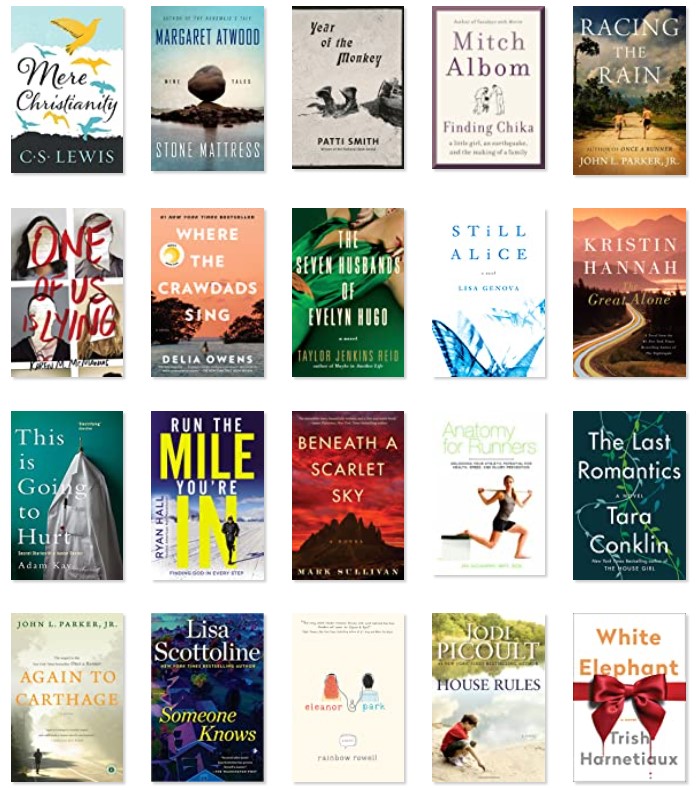
I kept a list of books I read last year, so even though I listed what I read each month in my monthly recaps, I wanted to post a master list.  I read more than expected because I stayed at home more than expected this year.  2020 was the first year I used Goodreads, and I don't know why I didn't get an account before this year!  My Year in Books is here.
  1. Educated by Tara Westover
  2. Disappearing Earth by Julia Phillips
  3. The Power by Naomi Alderman
  4. Framed by James Ponti
  5. An American Marriage by Tayari Jones
  6. Careful What You Wish For by Hallie Ephron
  7. Do Not Become Alarmed by Malie Meloy
  8. You'll Never Know by Halie Ephrom
  9. Dead Sea Rising by Jerry B. Jenkins
  10. Daisy Jones and the Six by Taylor Jenkins Reid
  11. Night Night, Sleep Tight by Hallie Ephrom
  12. Goodbye, Vitamin by Rachel Khong
  13. Waiting for Tom Hanks by Kerry Winfrey
  14. Once a Runner by John L. Parker, Jr.
  15. Ask Again, Yes by Mary Beth Keane
  16. White Elephant by Trish Harnetiaux
  17. House Rules by Jodi Piccolut
  18. Eleanor & Park by Rainbow Rowell
  19. Someone Knows by Lisa Scottoline
  20. Again to Carthage by John L. Parker, Jr.
  21. The Last Romantics by Tara Conklin
  22. Anatomy for Runners: Unlocking Your Athletic Potential for Health, Speed, and Injury Prevention by Jay Dicharry
  23. Beneath a Scarlet Sky by Mark T. Sullivan
  24. Run the Mile You're In: Finding God in Every Step by Ryan Hall
  25. This is Going to Hurt: Secret Diaries of a Junior Doctor by Adam Kay
  26. The Great Alone by Kristin Hannah
  27. The Seven Husbands of Evelyn Hugo by Taylor Jenkins Reid
  28. Still Alice by Lisa Genova
  29. Where the Crawdads Sing by Delia Owens
  30. One of Us is Lying by Karen M. McManus
  31. Racing the Rain by John Parker Jr.
  32. Finding Chika:  A Little Girl, an Earthquake, and the Making of a Family by Mitch Albom
  33. Year of the Monkey by Patty Smith
  34. Stone Mattress:  Nine Tales by Margaret Atwood
  35. Mere Christianity by C.S. Lewis 
  36. A Good Man by Ani Katz
  37. Lilac Girls by Martha Hall Kelly 
  38. Anatomy, Stretching, and Training for Marathoners: A Step-by-Step Guide to Getting the Most From Your Running Workout by Jay Dicharry
  39. Noel Street by Richard Paul Evans
  40. The Couple Next Door by Shari Lapena
  41. Seven Day of Us by Francesa Hornak 
  42. The Tenant by Katrine Engberg
  43. Red at the Bone by Jacqueline Woodson
  44. Life Will Be the Death of Me:...and You Too! by Chelsea Handler
  45. Inside the O'Briens by Liss Genova
  46. Nothing to See Here by Kevin Wilson
  47. A Nearly Normal Family by M.T. Edvardsson
  48. Wonder by R. J. Palacio
  49. The Alice Network by Kate Quinn
  50. Wait Till Helen Comes: A Ghost Story by Mary Downing Hahn
  51. A Spark of Light by Jodi Picoult
  52. Funny, You Don't Look Autistic: A Comedian's Guide to Life on the Spectrum by Michael McCreary
  53. 90 Minutes in Heaven: A True Story of Death and Life by Don Piper and Cecil Murphey
  54. The Dead Girls Club by Damien Angelica Walters
  55. A Stranger in the House by Shari Lapena
  56. Have a Little Faith: A True Story by Mitch Albom
  57. All We Knew But Couldn't Say by Joanne Vannicola
  58. Ungifted by Gordon Korman
  59. A Grown-Up Kind of Pretty by Joshilyn Jackson
  60. Girl, Wash Your Face by Rachel Hollis
  61. The 7 1/2 Deaths of Evelyn Hardcastle by Stuart Turton
  62. The Daughter in Law by Nina Manning
  63. Backseat Saints by Joshilyn Jackson
  64. Why Not Me? by Mindy Kaling
  65. Before You by Amber Hart
  66. Crazy Rich Asians by Kevin Kwan
  67. I Let You Go by Clare Mackintosh
  68. Three Wishes by Liane Moriarty
  69. Before I Let You Go by Kelly Rimmer
  70. Tell the Wolves I'm Home by Carol Rifka Brunt
  71. The Girl Who Stopped Swimming by Joshilyn Jackson
  72. Nine Perfect Strangers by Liane Moriarty
  73. Sharp Objects by Gillian Flynn
  74. Me Talk Pretty One Day by David Sedaris
  75. 84K by Claire North
  76. After Us by Amber Hart
  77. Extremely Loud & Incredibly Close by Jonathan Safran Foer
  78. Water for Elephants by Sara Gruen
  79. Dark Places by Gillian Flynn
  80. The Identicals by Elin Hilderbrand
  81. Hatchet by Gary Paulsen
  82. The Familiar Dark by Amy Engel
  83. The Guernsey Literary and Potato Peel Pie Society by Mary Ann Shaffer
  84. The Cactus by Sarah Haywood
  85. The Storyteller by Jodi Picoult
  86. House of Salt and Sorrows by Erin A. Craig
  87. Running with Sherman by Christopher McDougall
  88. Evvie Drake Starts Over by Linda Holmes
  89. The Dance by Richard Paul Evans
  90. The Family Upstairs by Lisa Jewell
  91. The Nickel Boys by Colson Whitehead
  92. An Unwanted Guest by Sherri Lapena
  93. Maybe You Should Talk To Someone by Lori Gottlieb
  94. Someone We Know by Shari Lapenda
  95. An Anonymous Girl by Grer Hendricks
  96. The Turn the Key by Ruth Ware
  97. Harbor Me by Jacqueline Woodson
  98. Suspicious Minds by Gwenda Bond
  99. The Benefits of Being an Octopus by Ann Braden
  100. The Ballad of Songbirds and Snakes (The Hunger Games #0) by Suzanne Collins
  101. I Know This Much is True by Wally Lamb
  102. Love & Gelato by Jenna Evans Welch
  103. Same Kind of Different as Me: A Modern Day Slave, an International Art Dealer, and the Unlikely Woman Who Bound Them Together by Ron Hall, Denver Moore, and Lynn Vincent
  104. Know My Name: A Memoir by Chanel Miller
  105. Minor Dramas & Other Catastrophes by Kathleen West
  106. The Sun Does Shine:  How I Found Life and Freedom on Death Row by Anthony Ray Hinton
  107. Stolen Children by Peg Kehret
  108. The Story of Arthur Truluv (Mason #1) by Elizabeth Berg
  109. Night of Miracles (Mason #2) by Elizabeth Berg
  110. The Confession Club (Mason #3) by Elizabeth Berg
  111. Plain Truth by Jodi Picoult
  112. The Case Against Sugar by Gary Taubes
  113. The Party Upstairs by Lee Conell
  114. Bring Me Back by B.A. Paris
  115. The Things We Cannot Say by Kelly Rimmer
  116. The Weight of Blood by Laura McHugh
  117. Me and White Supremacy by Layla F. Saad
  118. The Bad Beginning (A Series of Unfortunate Events #1) by Lemony Snicket
  119. The Help by Kathryn Stockett
  120. The Mighty Miss Malone by Christopher Paul Curtis
  121. Orbiting Jupiter by Gary D. Schmidt
  122. The Giver of Stars by Jojo Moyes
  123. Elanor Oliphant is Completely Fine by Gail Honeyman
  124. The Reptile Room (A Series of Unfortunate Events #2) by Lemony Snicket
  125. The Wide Window (A Series of Unfortunate Events #3) by Lemony Snicket
  126. The Miserable Mill (A Series of Unfortunate Events #4) by Lemony Snicket
  127. The Austere Academy (A Series of Unfortunate Events #5) by Lemony Snicket
  128. Sworn to Silence by Linda Castillo
  129. In Five Years by Rebecca Serle
  130. The Curious Charms of Arthur Pepper by Phaedra Patrkc
  131. The Ersatz Elevator (A Series of Unfortunate Events #6) by Lemony Snicket
  132. The Vile Village (A Series of Unfortunate Events #7) by Lemony Snicket
  133. The Hostile Hospital (A Series of Unfortunate Events #8) by Lemony Snicket
  134. The Carnivorous Carnival (A Series of Unfortunate Events #9) by Lemony Snicket
  135. The Slippery Slope (A Series of Unfortunate Events #10) by Lemony Snicket
  136. The Grim Grotto (A Series of Unfortunate Events #11) by Lemony Snicket
  137. The Penultimate Peril (A Series of Unfortunate Events #12) by Lemony Snicket
  138. The End (A Series of Unfortunate Events #13) by Lemony Snicket
  139. Goodbye Ed, Hello Me by Jenni Schaefer
  140. How to Find Love in a Bookshop by Veronica Henry
  141. What Are You Going Through by Sigrid Nunez
  142. History of Wolves by Emily Fridlund
  143. Pray for Silence by Linda Castillo
  144. Then She Was Gone by Lisa Jewell
  145. The Beatrice Letters (A Series of Unfortunate Events) by Lemony Snicket
  146. Me Before You by Jojo Moyes
  147. And Then There Were None by Agatha Christie
  148. The Glitch by Elisabeth Cohen
  149. The Girl You Lost by Kathryn Croft
  150. American Dirt by Jeanine Cummins
  151. After You by Jojo Moyes
  152. The Nightingale by Kristin Hannah
  153. What Alice Forgot by Liane Moriarty
  154. Monogamy by Sue Miller
  155. Still Me by Jojo Moyes
  156. Listen to the Marriage by John Jay Osborn Jr.
  157. When Sparrows Fall by Meg Moseley
  158. Just Mercy: A True Story of the Fight for Justice by Bryan Stevenson
  159. Lou in Lockdown by Jojo Moyes
  160. Before the Ever After by Jacqueline Woodson
  161. Thirteen Doorways, Wolves Behind Them All by Laura Ruby
  162. 28 Summers by Elin Hilderbrand
  163. The Rosie Result by Graeme Simsion
  164. The Book of Two Ways by Jodi Piccoult
  165. The Girl With No Past by Kathryn Croft
  166. No Happy Endings by Nora McInerny Purmort
  167. Restart by Gordon Korman
  168. Ordinary Grace by William Kent Krueger
  169. Anxious People by Fredrick Backman
  170. The Testaments (The Handmaid's Tale #2) by Margaret Atwood
  171. Night Road by Kristin Hannah
  172. Orphan Train by Christina Baker Kline
  173. All the Bright Places by Jennifer Niven


Friday, December 18, 2020

Mad at the Marathon

I've heard comparisons between running and abusive relationships, such as "when it's good, it's so good, but when it's bad it's terribly painful and heartbreaking."  The highs are so high we keep chasing them regardless of how low the lows.

The marathon and I have mostly a great relationship.  The majority of my 30-some marathons have been amazing experiences and I've been able to run about the times my fitness indicated, or when I was way off it's been glaringly obvious why (bronchitis, or when I ran 5 marathons and 4 halves in 3-4 months).  From late 2017 to early 2020, I wanted more than the marathon was willing to give, but I kept coming close enough that I was convinced it would give it to me the next time.  I could never squeeze out those last 68 seconds, but I still knew that on a less windy day or a slightly faster course, I could find myself at the relationship finish line under the time cut off.

2020 happened, and due to my wonky-shaped bones I missed the November marathon I'd trained for.  Fortunately I only had to take 2.5 weeks off, during which I got an expedited PhD in hip impingement, and returned extremely hungry for every day runs and mileage.  What I didn't return hungry for was a re-do of the missed marathon or even a spring marathon.

Those who know me know I am always marathon training.  Marathon training or unable to run, there is nothing else.  I have just loved the marathon so much for so long, really since my second marathon in 2004 (the first one I really raced, and with a negative split).  That's not to say that we haven't had plenty of ups and downs between then and now, including a nearly 4-year hiatus during which I thought I was done with competitive running (2011 to mid-2014), but through it all I still loved my 26.2s.  And I still do, but I guess this fall situation made me realize that I'm also mad at the marathon for not giving me quite enough!  I mean, I gave it everything I had and it just couldn't give me that last bit of time I worked so hard for, and then this year it had the audacity to give me a DNS.

Do I hope to PR-chase again?  Do I still have a bone to pick with 2:45:00 (regardless of what the 2024 standard is)?  Yes.  But I also accept that my PR may always be 2:46:08, which is still something for someone who for most of her marathoning career never even dreamed of seeing a finishing clock starting with a 2, and then fully believed that her absolute limit was 2:59:59.  All times and paces aside, I've found great joy in the marathoning journey, and that alone makes me confident that I'll be on it again.

So really, I'm kind of everything at once at the marathon.  In love with, mad at, thankful for, curious about, appreciative of, uncertain about, and plenty more adjectives that escape me at the moment.

I'm not planning to run a spring 2021 marathon*, and I am currently able to run (a solid amount at that)!  I'm not even sure who I am anymore.  ;-)

While I've had my share of being mad at races, at workouts, at injuries, at the weather, at my body, etc., I don't think I've ever been mad at running.  Running nearly every day is my big dream goal and anything else I can do is bonus!

*I fully reserve the right to change this decision at any time.

Saturday, November 21, 2020

Hip Impingement Help

I wish I'd have found a list of advice like this when I initially found out I had hip impingement, so in case anyone else is struggling with this issue, I wanted to share:

*Stop running anytime you have pain. With this issue, pain begins before any damage occurs (our bodies are that smart!), so I have never had any injury to my labrum or hip cartridge because I have not run through pain.

*Stop sleeping on your side, which sounds so simple yet is challenging if you love your side sleeping like I do! I have changed to a back sleeper, although occasionally if I wake up a little before my alarm I'll give myself the treat of sleeping on my side for an hour or less.

*Start working on your proprioception by learning to stand on one leg with your eyes closed. I can stand on one leg all day with my eyes open, but when I first started working on this just a couple of seconds with my eyes closed was game over. I am now up to about 30 seconds on my weak side and 60 seconds on my strong side on good trials, but I want to get more predictably consistent.

Single leg balance!

*Start doing traction with a band to "pull" your femur bone away from your pelvis. This is kind of hard to explain, but see photo below and feel free to comment with questions.  Lateral hip distraction with a band has also been helpful, and you can easily find videos of how to do it online.

Traction

*Strengthen your psoas and adductor muscles, as well as the internal and external rotators of your hips. Learning exercises to isolate these areas seemed to be a game changer for me.

*Hit single leg strength, balance exercises, and core work hard - I was already doing these but I think we can all do better on extras like this! The more running-specific the better.

*Stop yoga. I think yoga was helping my hip in the short-term but hurting it in the long run (same with stretching my hip flexors aggressively).  My yoga time seems to be better spent on strength training, which is unfortunate since I like yoga better.

*Use a standing desk - I was already doing this often but have been more vigilant about it.

*Stop holding tight to running goals (this is a nicer way of saying "give up"). The first time I got over this hurdle I'd acquiesced that I would not be able to really run again & I was training for a century bike ride. This time I gave up real quick & decided I'd train to ride my ElliptiGO 100 miles. It sounds counter-intuitive, but I really do think that giving up was helpful to me on this journey.  This may not be the case for everyone though!

I doubt my story with this issue is over, but I am thrilled about how much I have learned about it and that I am currently running (after just 2.5 weeks off this time) - researching it was seriously my part-time job for about 10 days! I hope that my work can help someone else who feels hopeless about having weird hip bones.

Wednesday, October 28, 2020

What Hippened

Sometimes you do everything right but things still go wrong. You foam roll every day, activate your glutes before every run, do yoga 5-7 days a week, strength train 2-3 times a week, run conservative mileage and workouts compared to previous recent marathon builds, and even skip a few workouts out of an overabundance of caution.  We like to think that there is always a reason when bad things happen, especially when they happen to other people, since we need to rationalize why that won’t happen to us, but that’s not always the case.  My hip pain has returned (history here), but I really don't think there is anything I could have done differently, and my doctor agreed.
When you are so in sync with your training
buddy that you have pains that require
cross training on the same days...
Ever since I returned to running in June after 4 months off dealing with a hip impingement, I've had tightness off and on with the same hip.  It's always loosened up within a few minutes, sometimes within a few steps, and hadn't impeded my training until last week.  I was super cautious with it and even if it was just a little too tight I'd skip a workout or plyometrics, but I also figured it might always be a little "off" because hip impingement doesn't go away - but what is also puzzling is that I've always had it, yet ran for years without knowing it.  I'd also noticed that my left side is weaker and lacks power compared to my right side, which I never felt when running but could tell when I did things like single leg hops.

On October 17, I ran a long progression run, and my hip tightened up afterward, but after yoga and foam rolling it felt fine.  No problems on October 18, then on October 19 I ran twice in cold drizzle/rain (it was raining pretty much all day, plus being a work day I didn't have much flexibility in run timing), and it was tight on both runs - enough that even though I thought it was the weather, I told one of my running buddies I might skip my workout the next day.  I felt 100% on my warm up for the October 20 workout, so I ran it and felt fine doing so, but on my cool down I really limped in.  I stretched and foam rolled when I got home, which seemed to help some, and then I had to travel for work and spent almost 3 hours sitting in the car.

On October 21 I got up to run and did not want to go, which almost always means I shouldn't (I have finally learned this!).  I foam rolled and did some glute activation, then did a trial run across my hotel room to ensure I wasn't just being a baby, and went back to bed.  I thought maybe it would feel better after work when it was warmer, so I tried a run then but stopped less than 100 meters in due to sharp deep pain.  The same thing happened on October 22, and then I really acquiesced that this was An Issue.  I made an appointment with a new sports doctor who came highly recommended by a friend, and also asked my previous sports doctor to call in another PT order.

I saw the new doctor on October 26, and she confirmed a hip impingement, pincer type. She said I have it on both sides, but my left side is hurting because of other factors including my left leg being a little longer than my right and the ways my legs have slightly different external/internal rotation and pronation. Impingement refers to the shape of my bones.
Pincer type is on the far left
The doctor adjusted my hips to be more even. She told me to work on proprioception every day (balance with eyes closed), and to work on loosening up my hip flexors and quads, especially on the left, as well as the IT band on the right.  She also said that I didn’t do anything wrong to cause this (no training errors) and that even a millimeter change in movement patterns can cause pain like this with a hip impingement. That kind of makes sense because both times I've developed issues with it were after running in cold rain, when I may run slightly differently. She said to just go by pain level on returning to running.

Everything she said made sense and was logical.  Running is a series of single leg hops, it's all a chain, and running is repetitive so even a little bit of "offness" multiplies.  I’ll work on my balance a lot and take it day by day on returning to running. I'll pay even more attention to my hip flexors and continue to strengthen all surrounding areas.  It's good to know I didn't do anything that caused it and it's nice not to have any restrictions on running, but I wish I knew more about the timeline.  I'm really glad I have my ElliptiGO now though!

The marathon doesn’t owe me anything, nor does marathon training. I’m disappointed that I won't be lining up for my planned race on November 1, but I’m a lot more concerned that this hip impingement issue is something I’m always going to have to deal with now. Sometimes bad things happen, because God cares more about our character than our comfort.  I've already gotten over missing my marathon (the circumstances made that pretty easy - it was a small local one and I'm not in PR shape), but I just don't think I could ever get over an end to my running career and I pray I won't have to try!

Friday, September 18, 2020

2020 20k (Random Friday Time Trial #2)

The idea to run a 20k time trial started because I was registered for the Dam to DSM 20k race.  I'd entered long before it rescheduled then turned virtual (before COVID and even before my hip issue!).  The virtual race window was August 31 through September 7 and I planned to run a hard 20k on September 5, but due to being overly cautious with a hamstring I tweaked lifting I ended up just running an easy 20k that day.  The hammy was back to 100% just a few days later, and for some reason I still wanted to run a 20k, so Christian and I both asked our coaches if we could run it on Friday, September 18.

I have no idea why I thought September 18 was a good day to run it; my wedding anniversary is September 17 and Albani's birthday is September 18, not to mention that Albani had a cross-country meet the evening of September 17, I teach an MSU class on Thursday evenings, and I have an 8:00 patient at work on Friday mornings.  Clearly this was not a well thought out plan, and I ended up being pretty unexcited about it.  But I also didn't have any legitimate reason not to run it, and I didn't want to let Christian down since we were planning to work together.  She hadn't felt very good on September 5 so was glad we'd rescheduled, and the weather ended up being much cooler on September 18 too.  I guess the only disadvantage of switching was that we had to start at 5 a.m. and run in the dark due to it being a work day!

Christian, Colin, Missy, and I were the brave souls who showed up to run.  We did a 2 mile warm up, a quick pee stop, and then decided where we should start.  We planned to run two loops of a course we call "The 6 mile loop" that is actually 5.8 miles.  After we finished the second loop we would continue straight until we hit 20k (12.43 miles).  No roads in my area are flat, but this was the flattest course we could think of where we wouldn't have much traffic and that wasn't our workout loop (the workout loop is 0.82 so a 20k would be a lot of laps, although I have run 20 miles on that thing before).  The course we chose ended up having about 520 ft of elevation gain.

We started off with Colin immediately jumping out front as expected, Christian and I falling in side by side, and Missy tucking in behind us.  I figured I could do about 6:30 pace for a 20k on the course we were on, but I wanted to start off a little slower, so I looked at my watch during the first mile and to see the first mile split in 6:38.  I was aiming for 6:40, so was pretty much right on, and I didn't look at my watch again during the run.

It was nice working with Christian, although with much less talking than our easy runs together!  I felt average at the beginning, and the pace felt do-able but my motivation wasn't great.  But the miles clipped by as we chased Colin's blinking Noxgear vest in front of us, and by the time we finished the first almost 6 mile loop I felt fantastic.  Just needed to get those endorphins flowing I guess!  I also started thinking about past half marathon races - fond memories.

During mile 7 I inadvertently pulled away from Christian.  I was feeling good and staying pretty steady, and she slowed just slightly.  I yelled encouragement and continued on, although I didn't push myself nearly as hard for the final 5 miles as I would have if I'd been with someone.  I have always been someone who races (truly races, not pitch dark country road time trials!) much faster than I train, and it always blows my mind to see people run race pace for nearly race distance or to PR in training.  In fact, one reason I wanted to run this was because typically the pace I can do for 12-14 miles in training is about what I can race for a marathon, and I'm probably going to run a November marathon, so I thought I'd have a good gauge on where I was at from this run.

The second loop was just as uneventful as the first, and I felt strong through the finish but never fast, which is pretty much where my fitness is at right now - solid but not sharp.  I ran a little too far, stopping my watch at 1:20:56 at 12.47 miles.  My average pace was 6:29, which calculators tell me is a 1:20:35 20k.  This is technically an unofficial PR since I have only run one 20k race ever, although I have run much faster 20ks in half marathons and my marathon PR is 6:19 average pace.  But!  I'll take what I can get in 2020!  I wouldn't count a Garmin PR anyhow, but one reason we ran a 20k instead of a half marathon was so everyone could unofficially PR (maybe we will do a 25K next, hah!).  I was also pretty excited that I estimated my current capability so closely with my 6:30 pace estimate, although I really don't know what I based that on aside from one 6 mile tempo run at 6:26, hah.

You can see my Strava activity with splits and elevation here.

Colin averaged 6:14 pace and Christian 6:33; both were pleased with their results.  Missy stopped at 6 miles due to tummy troubles, but she is in incredible shape and ready to sub-3:00 this season.  After cooling down to 17 miles I rushed home and went to work!  I didn't have time to stretch or roll like I typically do after runs, but after a lunch break walk and yoga session I felt great.

I'm glad that I did this, because it was fun and I really love long efforts.  I also finished with some gas still left in the tank and ready for more.  Now that I've been back to running for 3.5 months it's becoming harder not to compare to my previous times.  I'm not back there, but I'm determined to chase down 2019 Sara at some point!
We called this #seewhathappensseptember


Monday, August 24, 2020

Random Friday 5K Time Trial

Since I don't expect to have many/any race recaps this season (thanks, COVID-19), I thought I'd recap some of the time trials I do. Next time I'll have a better name - my running group may do a "Pick Your Poison" track time trial in September.

My coach put a 5k time trial on my training schedule for August 21.  I think she mainly wanted to see where I was at and get my max heart rate.  I knew I wasn't in top shape so it didn't feel like a big deal, but at the same time I treated it like an actual race.  Even though I wasn't in PR form, I still wanted to get the best out of myself that morning.  I drank Generation Ucan and caffeinated nuun when I woke up, and also sipped on more nuun between my warm up and the time trial.  I wore an old pair of racing shoes, changing shoes after my warm up which always helps with the mental "I'm going to run fast" piece.

When you wear 3 different pairs of shoes
during the course of a run, you mean business

I'd run a 2 mile time trial one week before in 12:13.  I hadn't felt the best that day, and ended up having mixed feelings about the result - it would have been a good time for me 5 years ago but was slower than my PR half marathon pace from 2019.  I mostly looked at it as information, plus after 15.5 weeks off from February through May I'm thankful to run any pace.  For some reason, I just knew I was going to have a better day for the 5k time trial, so I decided I'd try to run it at the same pace, or about 6:06, hoping to sneak in under 19 minutes.  It was 58 degrees, which I also knew would help immensely (it was 72 with 100% humidity for the 2 mile).

Three friends (Casey, Rebecca, and Missy) decided to run the time trial with me, which made it exponentially more fun!  We warmed up together, and Missy and Rebecca said they planned to run the 5k, while Casey was undecided.  She ended up deciding she'd do about 2 miles, and try to stick with me (if you know Casey, you know that means be a step ahead of me!).  And, we were off!

Casey and I settled in side by side, at a clip that felt fast but reasonable, with Missy and Rebecca right on our heels.  I looked at my watch once early to see 6:03 average, which was about what I wanted.  I focused on working with Casey, and we went through the mile in 5:54.  Her watch beeped a little before mine for a 5:50 first mile, and she stopped at that point.  I was expecting her to run through at least 2 miles, and kind of thought she'd end up running the whole 5k with me then probably out-kicking me, so that threw me momentarily since running with her had helped so much.  I could hear Missy fairly close behind, though, so that helped me keep pushing, although I did let up a little during mile 2 for a 6:02.  Casey jumped back in with me for a bit during the final mile (we were on a 0.8 mile loop course), which helped tremendously.  I was determined I was going to get my pace back under 6:00 for the final mile, and I did that with another 5:54 and a final 0.13 kick at 5:36 pace.  I stopped my watch a little late, at 3.13, but I figure most road courses with turns read a little long anyway.  My time for the 3.13 was 18:35, with an average pace of 5:56.  The activity is on Strava here.

I was really happy with this one!  I thought 6:05 pace would be a fantastic day right now, so exceeding that was exciting, but also I just felt so good while I was doing it.  The cooler weather was a huge factor, but I'm getting stronger again and it's a great feeling.  In mid-June my heart rate was 170 (it averaged 168 for this 5k) running 7:45 pace - I am not exaggerating!  I started some workouts with Christian in July but typically felt like I was just hanging onto her.  The way I felt during this run was how I want to feel! 

How Rebecca felt after the time trial (Casey and I walking in
the distance as I recovered for the 400s)

After the 5k I had a full recovery then 5 x 400 m.  Unsurprisingly no one else wanted to do the 400s.  My splits were all over the place - 1:23-1:32 - but I got them done.  My legs were heavy but also I didn't have the mental energy to run anything else hard.  Afterward I texted my coach that the 5k went well, the 400s not so much!  She said that was how it was supposed to be.  :-)

The Missouri state road racing record for my age (39) is 18:33, so now I want to find a certified 5k race in the state that is actually happening before my birthday on October 26 - which so far hasn't been a fruitful search.  There are a lot of small 5ks, but very few are certified.  I do appreciate the irony that I am actually seeking out a 5k - I am not 5k runner, but I really enjoyed this time trial!

Monday, July 13, 2020

Beyond Boston: Dean Gartland

I've known Dean virtually for about 10 years.  He is a very talented runner -- he ran his first sub-3:00 ten days before his 57th birthday and is working on running 25 consecutive Bostons!  He is also a really caring runner who has made amazing wooden projects for most of the Loopsters over the years (I have some amazing Christmas ornaments from him that I'll add a picture of after Thanksgiving when I next dig that box out!).  His enthusiasm for the sport and for Boston shine through in his interview, and I have a feeling he will accomplish his goal of placing in the top 3 in his age group at Boston soon!
Introduce yourself (who you are, where you're from, what you do, etc.).
Hey, I'm Dean Gartland from Louisville, KY.  I am a woodworker by trade and it's something that I love. Woodworking is also a hobby of mine next to running. I am the second oldest of ten kids. I was always running growing up either from my only older brother or chasing after one of my younger brothers.

How did you get started in running? Tell us a little about your early running career through present.
I started running in 1987 after talking to a guy who worked for me about our local half marathon at Derby time. He encouraged me to run a local 5K in a couple of weeks so I started running to be able to do that. Next was a 10K then a 15K followed by the half marathon. The only goal I had was to finish it in under two hours. Met that goal by a couple of minutes. 

I was hooked and wanted to run even more then. The longer the race the better but the only race I could find after that were 5Ks. I didn't have a clue how to train so I would just go out and run as hard as I could every day. My knee would sometimes hurt so bad after an hour of running I thought it would just explode but I kept on running. I would get home and could barely get out of the car and would hobble and hop to the house. This type of training went on until 1993 when I decided to give up running. I had lost interest, I hadn't met any new friends through running, and my wife and I had split up.
Why did you decide to run your first marathon?  What was your journey to BQ like? 
In 2007 my oldest daughter called me and told me how much she loved me taking her to races so that she could watch me finish and even got to run in some of the kid dashes. She told me that it would be great if we could both run that local half marathon the last Saturday in April. I agreed. At 5'5" and almost 190 lbs I was in no shape to run. I stopped at my favorite park after work and couldn't complete 1/8 of a mile. Boy was that an eye opener. My daughter had not only gotten me to run it but three of my brothers, a sister, and my sister-in-law. I ended up running that half marathon and loving it just as much as my first. At our little after party I announced that the following year I would be 50 years old and would run the full marathon in 2008. My daughter's mouth just dropped as she asked me if I was sure that I could do that. With a huge smile I told her I could.

So in January I decided that I need to get some help with this training stuff that I really knew nothing about. I found the local Fleet Feet running store where they had running groups meet on Wednesdays for a run and Saturdays for long runs. I showed up with my walkman on my hip and head phones around my neck. The owner pointed me to this group of older men to run with. I thought "Good a group that I'll be able to impress" When I asked them what they were going to run that Wednesday I was told that they were going to do hill repeats. Wasn't real sure what that was but asked if I could run along. After a mile warm up they explained that we would slowly run down this hill and at the bottom do a "U" turn and sprint back up. We would do this six times. No problem I thought since my local park was nothing but hills. Fast forward to Thursday morning when I could hardly walk getting out of bed to go to work. OMG I was so sore.That was just the beginning to so many great training runs with that group.

Soon it was the last Saturday in April and I was on the starting line of my first full marathon. As I ran past mile 25 my new training partners jumped in with me to run my last mile all the time yelling at the crowd that I was just about to qualify for the Boston marathon. I had no clue. After I finished sure enough I had run my first marathon (3:33:26) and qualified to run Boston in 2009. I just had to do it! But thought that it might just be my last marathon because those things really hurt.

The following year (2009) I trained hard and got registered for Boston 2009. One of my younger brothers and his wife told me that they would take care of my room in Boston because they were going to cheer me on. I ended up running my first Boston and only my second marathon one second faster that my first one. 3:33:25. That was the most awesome experience I had ever lived through at that time next to the birth of my daughter. I was going to be going back again the following year. 

One thing I just couldn't get my head wrapped around was the fact that I had just trained over 800 miles to run a 26.2 mile race. Seemed there should be a better way to use all of that training. That fall I ran both the Chicago Marathon and Las Vegas Marathon. I kept on until I was running six marathons a year.

In 2014 I decided that I wanted to now shoot for a sub-3 hour marathon. In February I ran a 3:01 which beat my 2013 Chicago marathon time of 3:02. Right before the 2014 Chicago marathon my training was going so good and my confidence was sky high, but four weeks before the marathon my Achilles started to bother me so much that I would limp the first couple of miles of every run. I had to get this fixed. I stopped running and only got in 5 or 6 runs the last four weeks before Chicago. At the Chicago marathon expo I had a doctor do an ultrasound on my Achilles to find out if I was going to be able to race the following day. He said he could see why I was in pain but should be okay to race. I was all smiles. I crossed the finish line the next day, (10 days before my 57th birthday) with a time of 2:59:52. I hit another goal!
What are your thoughts on Boston 2020 being cancelled? How did you handle the initial postponement and eventual cancellation, mentally and physically?
It was heartbreaking to see that the Boston marathon was first postponed then canceled in 2020, but that was the only right thing to do. I had started my training for the April Boston in November. Getting my mileage up and really just getting in shape for the hard stuff that would start in December. Once I had heard that the Boston was going to be moved to September I took a few easy weeks before once again starting up my training. Then again I get this message as I was getting out of my truck to go for a training run that Boston was now canceled for 2020. I stood there for a moment deciding not to push this run but instead to use it to reflect and calm down from the bad news. Running has helped me out through so many bad times.

Why did you decide to run Boston 2020?
Boston is everything that you have ever heard of about it. I've run 37 marathons now (all of them have been Boston qualifiers) and I can say that when people cross a finish line I see a lot of people break down and cry that they have completed a marathon. Boston is the ONLY marathon that I have seen so many people break down in tears at the starting line, I love this race and now can't see a year that I don't run it.
Do you plan to run Boston 2020 virtually? Why or why not?
I now have the opportunity to run Boston Virtually and that's what I'll do. This won't be a race or even a fast 26.2 miles but it will be a way of giving thanks for the ability to be able to do something that I love. There were so many questions to be answered and I think that the BAA did an excellent job of answering all of them. They were offering a commemorative bib for the first 15,000 entrants and I had to be one. A couple of day after I registered I received an email from the BAA letting me know that I was one of the first 15,000. Another goal met. 

Do you plan to run Boston 2021? Why or why not? 
Yes, I've run 11 consecutive Boston marathons and at this rate I'll get to join the quarter century club of 25 consecutive Boston marathons at the age of 75, another goal that I'm chasing, well that and finishing in the top three in my age group in Boston!

Friday, July 3, 2020

You cannot run too slow on your easy days

I've seen so many benefits from slowing down my easy runs that I want to tell the world so every runner can get these benefits.  Learn from my mistakes, everyone!  In the future I'll post more details about my personal experience, but in short, when I slowed down my easy runs I felt much stronger, had markedly fewer injuries/niggles, had reduced incidences of illness, experienced performance improvements (PRs in every distance from 5k to marathon at age 38-39), and began enjoying running even more, which I didn't even think was possible!  I think why many runners don't do it is because running faster can produce short-term gains, and we see those gains and think that it works - I have been guilty of thinking exactly that!  Plus it is fun to run fast and to say a certain "impressive" pace is easy. 

In this post I've linked and summarized some great articles on the topic that have been written by people who are more knowledgeable and faster than me. I mean, if Sally Kipyego runs her recovery runs at 8:30 pace or slower, why are 3:00 marathoners running theirs at 7:00 pace? 

The Two Simple Reasons Your Easy Days are Ruining Your Training
My favorite piece from this article is: "You cannot run too slowly on a recovery day, only too fast. Make sure you understand that. It is a simple concept that is notoriously hard to grasp."

The author notes, "In high school, I would often race my easy days around 6:45 mile pace and run my workout days around 6:30 pace. Ten years later, as a professional runner, I run many of my hard workouts at 5-minute mile pace or faster and my easy days at 8:30 pace or slower."  I have read in several places that a big difference between amateur and professional runners is that amateurs have a much smaller pace differential between easy pace and workouts, wheres professionals have a huge pace differential.  If you are running tempos at 7:30 pace and easy runs at 8:00 pace, you are either under-performing in workouts or over-reaching on easy days, and I would bet it is the latter!

The author also mentioned that going easy by "feel" is best for most runners, and while I agree with this after a person has learned to run easy, I see that a lot of runners don't know what it's like to actually run easy - they think they are doing it when they are running a moderate pace (I have been one of those people)!  "Easy" and "not hard" are not the same.
I mean, if you can't trust Runners World for training advice, who can you trust? Hah!

Running slow is very common with Kenyan-born runners, and no one can argue what distance running powerhouses they are. The article notes, "Sally Kipyego, an Olympic silver medalist in the 10,000 meters, can hold a sub-5:00 minute pace in the event. Achieving that requires Kipyego to log plenty of hard track sessions and tempo runs. Yet on her non-workout days, she ambles along at 8:30-per-mile pace, sometimes even slower."  Her easy pace is over 3:30 slower than her 10K pace, and clearly it works. Sally recently placed 3rd in the 2020 Olympic Trials.  Side note: It completely blows my mind that a woman can average 4:55 pace for 6.2 miles!

I've read this time and time again, and you will see it as a recurring theme in this summary: “The common denominator among most really successful runners, people running at a high level, is a really wide chasm between training-run pace and where they work out....Brenda Martinez, who has PRs of 1:57.91 for 800m and 4:00.94 for 1500m, is a perfect example of this. Under the guidance of coach Joe Vigil, she’ll run 8 x 1,000m repeats at 2:55 [that is 4:41/mile pace!], but on her easy days, she’ll run a 9-minute pace."

The article also advises "runners to use 10K race pace plus 2 minutes for easy-day pace, wear heart rate monitors (and aim for 65 to 70 percent of maximum heart rate), or take occasional treadmill runs to monitor pace."  While I am not at all a fan of treadmill running, it's clear there are benefits to setting it at a certain pace, whether easy or on a workout day, and letting it keep you there!  This article presents the other side of the coin too (faster easy days and when they might be appropriate).

How Fast Should Your Easy Runs Be?
This one provides great scientific explanations, and if you're interested in the science behind easy running make sure to read the whole article. Just like heart rate doesn't lie, science does not lie! It also breaks down a lot of common questions (e.g., "But if I feel good can I run faster?", "Don't I get more benefit from running faster?", "How slow is too slow?", etc.).

I have personally found that I will run a faster marathon off of almost all easy running than off of frequent workouts at a slightly lower mileage volume.  This is probably because,  "...nothing will consistently help you improve continuously like developing the aerobic system."

For the numerically minded (and really, what runner isn't), "Your optimal easy run pace for aerobic development is between 55 and 75% of your 5k pace, with the average pace being about 65 %....  Running faster than 75% of your 5k pace on your long run doesn’t provide a lot of additional physiological benefit....In fact, the research indicates that it would be just as advantageous to run slower as it would be to run faster...Even though 50-55 % of 5k pace will seem too easy, the research clearly demonstrates that it still provides near optimal physiological aerobic adaptation."

"Many runners have a distorted view of what 'easy' means".  This post summaries a couple of scientific studies and concludes that you cannot run too slow on your easy days and that easy pace should vary from day to day!  I think that's another sign of "not real" easy pace (or at least it was for me):  always running the same pace on easy runs, or stating ahead of time what your easy pace is going to be.

The post mentions the 2:00+ current 5k pace guideline for easy runs, which I've seen noted in numerous paces and based on my personal experience is pretty solid. 

Why Running Slow Can Eventually Help You Run Faster
I acknowledge that the slow easy runs method may not be best for short-term success.  If you are running one training block, you might be better off running faster every day.  But if that describes you, I doubt you're inventing the time to read this post, plus most runners I know are in it for the long-haul!

If the previous information isn't convincing you that this method works, perhaps this expert will scare you, "So if all your runs are too fast, according to Bartholic, you’re not developing the power system that you need for 97 percent of a race...Your maximum aerobic benefit is going to be running slowly....When you’re running slowly, and your injury risk is lower, you can run more often, more miles, and build up slowly,”

In the past I've fallen victim to thinking that I had to run a lot of workouts to get faster, but I had a similar experience to this: “You think you have to do a lot of speed work to get faster,” he said, “but after doing most of my runs at a slow pace my marathon finish time was much faster.”  

This article mentions how to calculate an appropriate easy pace based on heart rate, and also mentions the "talk test". I don't know how the talk test goes for others, but I can converse when running marathon pace but that is NOT an easy pace for me.

It's Okay To Run Slow, Really
If your race performance has plateaued or you've dealt with reoccurring injuries, slowing down your easy runs might be just what you need to break through.  It seems very counter-intuitive; we want to go pound workouts and pick up the pace every day to get faster, but "While some runners have success with faster paces on easy days (particularly lower volume runners), eventually even those runners usually see diminishing returns as aerobic adaptations from moderate running get tapped out." 

"Polarization essentially means that training is usually easy or hard, rather than a grinding-it-out moderate all the time. Lots of “grey-area” moderate running can increase injury risk and lead to stagnation due to the absence of adequate recovery and faster stimuli." When I was training for a goal pace of 6:15 for the Indy Monumental Marathon, I noticed that I rarely ran between 6:15-7:45 pace - the "gray area" for me (if I was hitting 7:15-7:30 at the end of an easy run it was only because someone I was running with was speeding up).  My workouts were at 5:30-6:15 pace, and my easy runs were 7:45-8:30 pace.  It wouldn't have hurt me to run easy runs slower than that - many runners who are much faster than me do.

How Running Slow Makes You Faster
Seriously, run slow to run fast.

"...as 2018 Ironman World Championships runner-up Bart Aernouts said... “a slow run can only be too fast, not too slow” [notice a reoccurring theme here?].  Bart’s really easy runs are paced between 6:54/mile and 8:03/mile. That’s not super slow, but some of you are likely running most of your runs at a similar pace – and you’re likely not one of only two men to finish the iconic Kona Ironman course in under eight hours, running a 2:45:41 marathon, averaging 6:19/mile after a 2.4-mile swim, and a 112-mile ride in the Hawaiian heat. If that’s the case, it’s time to slow it down."  I think that pretty much speaks for itself - a 2:45 marathon after swimming and biking for 5+ hours in terribly hot conditions in insane!

But what pace should we run?  "For non-elite athletes, coach Luke Humphrey...recommends 1:30–2:30 minutes per mile slower than goal race pace."  I'm not sure what race distance he is referring to, but less than 90 seconds per mile slower than any race pace is too fast to really be easy; well, unless you are one of those amazing people running 50 to 100 milers!

The article also mentions the importance of the other pieces of training programs, such as fast intervals.  While this post is not about them, workouts are obviously essential to race success and should be included in a training schedule in addition to the awesome easy runs we are focused on here.
This x 1000: "But just because you can push harder than a true easy pace doesn't mean you always should."  Just because you can run faster on easy days doesn't mean it's a smart idea!

This article also discusses the difference between marathoners running sub-3:00 vs. 4-6 hours, which I thought was a helpful distinction.  The faster you're racing, the more differential you should have between easy pace and marathon pace. A 2:59 marathoner needs to slow the pace down 1:30 or so per mile, while someone running a 4:30 marathon may only need to slow down by 0:45-1:15.

This is important for marathoners: "Part of doing those slower runs is that it teaches our bodies to burn fat, which is really important in a marathon because our carbohydrate stores only last so long," she says. "So the more efficient we are burning fat, the more we can push off hitting the wall."  This is also a good point I hadn't thought about until now, but when I was running easy runs too fast I was more apt to hit the wall.

What Pace Should My Easy Runs Be?
I personally experienced this: "More often than not, when a runner’s race times plateau it’s a sign that there’s not enough variety in the training program, they’re not recovering well from the work they’re doing day after day, or some combination of the two."

We runners always want a number!  "I recommend easy/recovery runs to be 90 seconds to 2 minutes per mile slower than your marathon pace."

The author discusses the easy runs of 2:13-2:14 marathoners: "with a majority of those runs in the 7:30 per mile pace range—nearly two-and-a-half minutes per mile slower than the paces they could race a marathon!"  If 2:13-2:14 marathoners are running easy runs at 7:30, I certainly don't need to be!

Using the 80/20 Rule to Balance Triathlon Training Intensity
While this article is clearly about triathlon and not running, the point about the "moderate intensity rut" is spot on. "Recreational triathletes spend a much smaller percentage of their training time at low intensity and a much larger percentage at moderate intensity" (compared to elites and professionals who perform much better).  Another case of running slower to perform better!

You Can't Run Too Slow on Your Long Runs!
I mean, the title says it all. He recommends marathon pace + 2:00.

In some ways it is harder to run slower for long runs, because it means significantly more time on feet!  This article isn't focused on advanced marathon runners, but I think it's important to note that if you are trying to work your marathon time down, workout long runs become very important, especially later in the training cycle.

I found this long article on base training after I wrote this original post, and it doesn't exactly fit in this post, but I wanted to add it to show the importance of aerobic development.  The author also notes that you'd be surprised at how well you can race off of lots of easy mileage plus some strides, and I have experienced that.  Now is the perfect time to train like that, since it's an investment in long-term development and we are unsure when races will happen again! 

Here are a few examples from some really fast people:
Nick, a 15:45 5k and 32:29 10k runner ran these PRs at age 37, bettering his college bests, after slowing down his easy runs to an average of 7:45.  Read his details here.

Shawanna calls it sexy pace! She is a 2:45 marathoner who runs a lot at 8:00-9:30 pace.  You can see one of such runs here, but her Instagram account and Strava are full of them (she is also the best ambassador for running positivity that I know - you can't help but smile and love running when you see anything she posts).

This post by Sam says it all - she ran 3 blazing fast mile time trials (in Alabama in June!), and her average pace for all of her running was 8:34.  Aside from her impressive 5:02 mile, she has also run a 17:20 5k and a 2:49 marathon with easy running from 8:00-9:00+.

Molly Seidel, the runner up in the 2020 Olympic Marathon Trials, posts all of her runs on her Strava, and her easy runs are usually 7:30-8:00 (relative to her 5:30 marathon pace!).

Keira D'Amato has been making headlines during quarantine, including time trialing a 15:04 5k and 4:33 mileHer Strava shows many runs between 8:00-9:00 pace.

Hiruni Wijayaratne is a 2:34 marathoner hoping to represent Sri Lanka in the next Olympics, and at the end of this podcast she notes that her easy days will be 9:00 pace, maybe 8:40.

Now is the perfect time to experiment in training, with no races for the foreseeable future.  If you try slowing down easy runs and don't like it, then you can always speed them back up.  In the words of Dr. Seuss, "You do not like them. So you say. Try them! Try them! And you may."